Power & energy
Pressurised water reactor
Nuclear power · Thermal power plant
 Open the interactive 3D model →
How can a few tonnes of uranium light up a city of a million homes without burning anything?
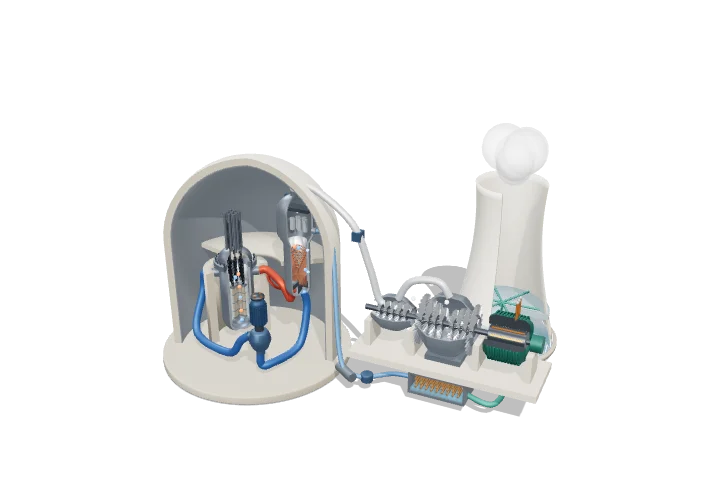
Inside the reactor, uranium atoms split apart and release heat. That heat warms water, which is kept at very high pressure so it cannot boil, and it is used to boil a second, separate loop of water into steam. The steam spins a turbine and a generator, just like in a coal power station.
A pressurised water reactor (PWR) uses heat from controlled U-235 fission to boil water in a separate secondary loop, and the resulting steam drives a turbine and generator. Keeping the primary water at about 15.5 MPa stops it boiling, so it can both cool the core and moderate the neutrons that sustain the chain reaction.
Key facts
- Typical rating (four-loop plant)
- ≈ 3400 MW thermal → ≈ 1100–1200 MW electrical
- Primary pressure
- ≈ 15.5 MPa (155 bar)
- Primary temperatures
- ≈ 290 °C cold leg, ≈ 325 °C hot leg
- Steam conditions
- ≈ 6–7 MPa, ≈ 280–285 °C, saturated
- Fuel
- UO₂ enriched to 3–5% U-235, in 17 × 17 assemblies
- Net thermal efficiency
- ≈ 33–35%
Parts you can explore (14)
- Containment building
- Reactor pressure vessel
- Fuel assemblies
- Control rods
- Steam generator
- Pressuriser
- Primary loop
- Reactor coolant pump
- Secondary loop
- Steam turbine
- Generator
- Condenser
- Cooling tower
- Coolant flow
In the 3D model
Rotate and take apart the model, follow a guided tour of what each part does and why it’s needed, change it with a live slider, and test yourself with a short quiz. Free, no sign-up.
Open Pressurised water reactor in 3D →
OpenArc Models’ models are simplified teaching schematics. Terms · Privacy