Power & energy
Pumped-storage hydropower
Energy storage · Hydropower
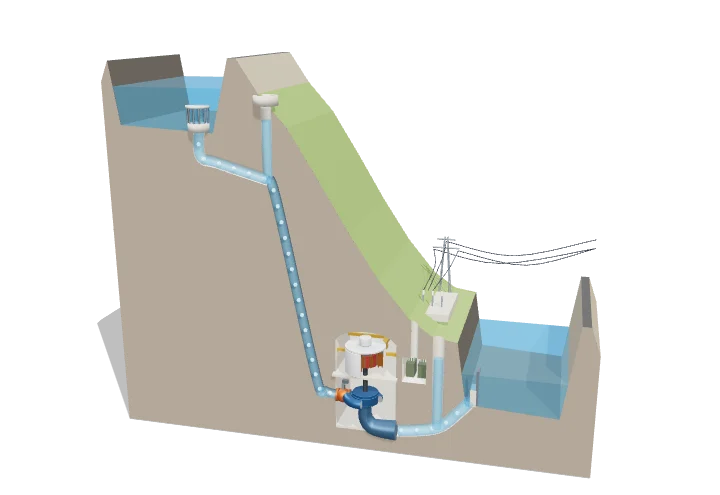 Open the interactive 3D model →
How can you store a whole city’s electricity for the evening using only water and a mountain?
When there is spare electricity, a pumped-storage plant uses it to pump water up into a lake high on a mountain. When people need power, the water runs back down through a spinning machine that makes electricity again. The same machine does both jobs: it spins one way to pump and the other way to generate.
Pumped-storage hydropower stores electricity by pumping water from a lower reservoir to an upper one, turning electrical energy into gravitational potential energy (E = ρVgh), and releases it by letting the water flow back through turbines. A single reversible pump-turbine and motor-generator does both jobs with a round-trip efficiency of about 75–80%, and pumped storage still holds over 90% of the world’s grid-scale stored energy (MWh).
Key facts
- Stored energy
- ≈ 1.36 kWh per m³ of water per 500 m of head
- Example scheme
- Dinorwig (Wales): 6 × 288 MW, ≈ 9.1 GWh, ≈ 500 m head
- Round-trip efficiency
- ≈ 75–80% (best modern plants ≈ 80–82%)
- Response time
- ≈ 10–20 s from spinning standby; ≈ 1–2 min from standstill
- Global capacity
- ≈ 180–200 GW installed (mid-2020s)
- Lifetime
- 50–100 years for the civil works
Parts you can explore (11)
- Upper reservoir
- Lower reservoir
- Intake, headrace and surge shaft
- Pressure shaft and inlet valve
- Reversible pump-turbine
- Motor-generator
- Powerhouse cavern
- Tailrace and surge chamber
- Transformers and switchyard
- Mountain and rock section
- Water flow
In the 3D model
Rotate and take apart the model, follow a guided tour of what each part does and why it’s needed, change it with a live slider, and test yourself with a short quiz. Free, no sign-up.
Open Pumped-storage hydropower in 3D →
OpenArc Models’ models are simplified teaching schematics. Terms · Privacy