Physics
Pulley systems and mechanical advantage
Mechanics · Simple machines
 Open the interactive 3D model →
How can one person lift something four times heavier than they could hold — just with rope and wheels?
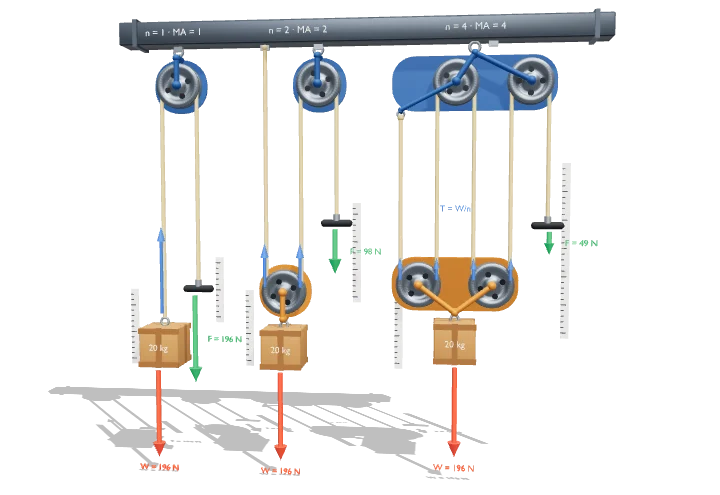
A pulley is a wheel that a rope runs over. If the rope loops back and forth several times between a fixed wheel and a wheel attached to the load, each loop of rope holds up part of the weight. You pull with less force, but you have to pull a lot more rope.
In an ideal pulley system one continuous rope carries the same tension everywhere, so if n rope segments support the moving block, each carries W/n and the effort needed is only W/n. The price is distance: every segment must shorten by the lift height, so the rope pulled is n times the lift and the work done is unchanged.
Key facts
- Ideal mechanical advantage
- IMA = n, the number of rope segments supporting the moving block
- Ideal effort
- F = W/n
- Velocity ratio
- rope pulled = n × load lift
- Model loads
- 20 kg each, W = 196 N
- Model efforts (ideal)
- 196 N, 98 N and 49 N for n = 1, 2, 4
- Typical efficiency of real tackle
- ≈ 80–95 % per sheave pair, falling as sheaves are added
Parts you can explore (11)
- Ceiling beam
- Fixed pulleys
- Movable pulleys
- Rope
- Loads
- Effort handles
- Load weight W
- Effort force F
- Rope tensions T
- Rig labels
- Measuring scales
In the 3D model
Rotate and take apart the model, follow a guided tour of what each part does and why it’s needed, change it with a live slider, and test yourself with a short quiz. Free, no sign-up.
Open Pulley systems and mechanical advantage in 3D →
OpenArc Models’ models are simplified teaching schematics. Terms · Privacy