Physics
Projectile motion
Mechanics · Kinematics in two dimensions
 Open the interactive 3D model →
At what angle should you throw a ball to make it go the farthest — and why?
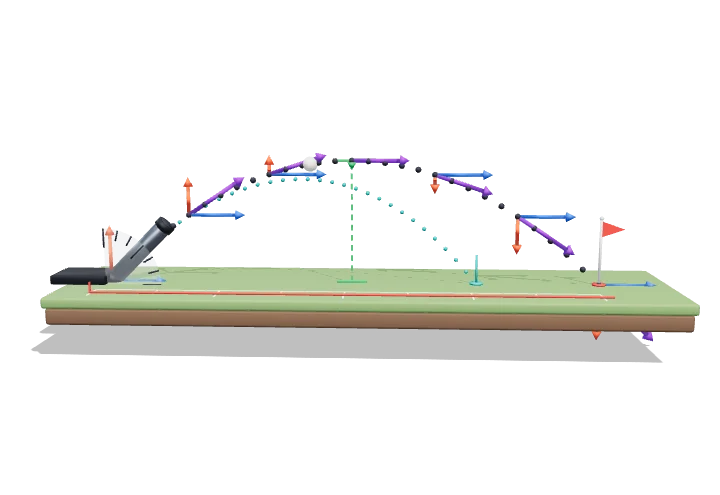
Once a ball leaves your hand, only gravity pulls on it (if we ignore the air). Gravity pulls straight down, so it changes the ball’s up-and-down speed but not its sideways speed. Put together, these two motions make the ball follow a smooth curve called a parabola.
Without air resistance a projectile moves with constant horizontal velocity and constant downward acceleration g, so its path is a parabola whose range, height and flight time follow directly from the launch speed and angle. Air drag breaks this symmetry, shortening and lowering the path and moving the best launch angle below 45°.
Key facts
- Model launch speed
- v₀ = 20 m/s from ground level
- Maximum range (θ = 45°)
- R = v₀²/g = 40.8 m
- Maximum height (θ = 90°)
- H = v₀²/2g = 20.4 m
- Flight time at 45°
- T = 2.88 s
- With drag (v_t = 30 m/s)
- best θ ≈ 42°, R ≈ 31 m
- Horizontal acceleration (no drag)
- 0
Parts you can explore (11)
- Ground and distance scale
- Launcher
- Angle protractor
- Projectile
- Trajectory
- Velocity vectors
- Horizontal component vx
- Vertical component vy
- Maximum height marker
- Range marker
- Air-resistance trajectory
In the 3D model
Rotate and take apart the model, follow a guided tour of what each part does and why it’s needed, change it with a live slider, and test yourself with a short quiz. Free, no sign-up.
Open Projectile motion in 3D →
OpenArc Models’ models are simplified teaching schematics. Terms · Privacy