Physics
Prism dispersion
Geometric optics · Refraction and dispersion
 Open the interactive 3D model →
Where do the colours of a rainbow come from — were they hiding inside white light all along?
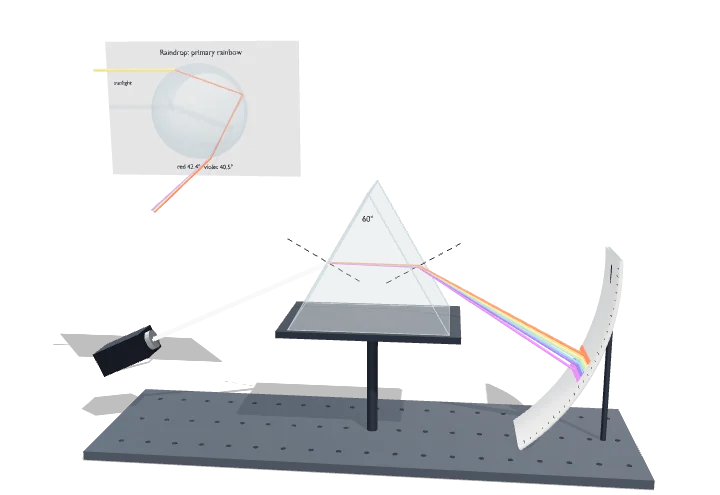
White light is really a mixture of all the colours travelling together. When light passes into glass it slows down and bends, and violet light bends a little more than red. A triangular prism bends the light twice, so the colours fan out into a rainbow-like spectrum.
A prism separates white light into its colours because the refractive index of glass depends on wavelength, so each colour is bent by a slightly different amount at each face. The same refraction, combined with one internal reflection, makes raindrops send red light back at about 42° and violet at about 40.5°, producing the rainbow.
Key facts
- Snell’s law
- n₁ sin θ₁ = n₂ sin θ₂
- Prism apex angle (model)
- 60°
- Flint glass index (model)
- 1.664 (700 nm) – 1.710 (400 nm)
- Minimum deviation, yellow (model)
- ≈ 53.7° at i ≈ 57°
- Primary rainbow angle
- ≈ 42° (red) to 40.5° (violet)
- Visible wavelengths
- ≈ 380–750 nm
Parts you can explore (9)
- Glass prism
- Light source
- White light beam
- Refracted rays in glass
- Dispersed beams
- Spectrum screen
- Normals
- Optical table
- Rainbow raindrop
In the 3D model
Rotate and take apart the model, follow a guided tour of what each part does and why it’s needed, change it with a live slider, and test yourself with a short quiz. Free, no sign-up.
OpenArc Models’ models are simplified teaching schematics. Terms · Privacy