Mechanisms
Gutenberg printing press
Mechanisms · History of technology
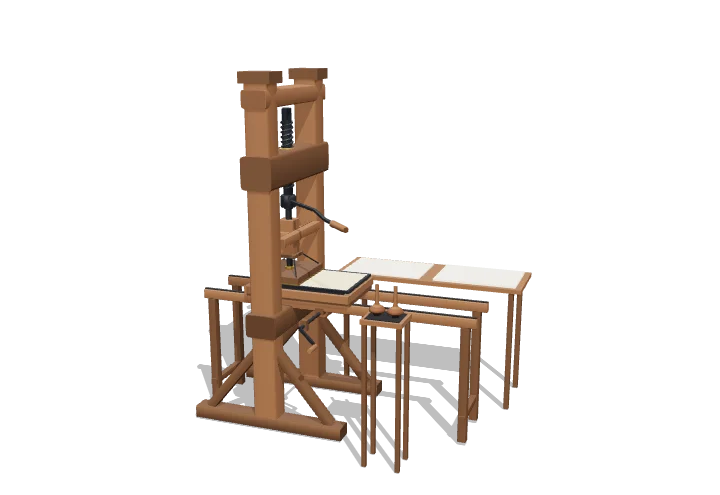 Open the interactive 3D model →
How did a wooden wine-press help spread books, news and ideas across Europe in just 50 years?
Before printing, every book was copied by hand, one letter at a time. Around 1450 Johannes Gutenberg made thousands of small metal letters that could be arranged into pages, inked, and pressed onto paper again and again. A long bar turns a big screw that squeezes the paper hard onto the inked letters, printing a whole page in one pull.
The hand press combined a screw press, adapted from wine and paper presses, with reusable cast-metal type, oil-based ink and a sliding carriage, making it possible to print identical pages quickly. Its mechanics are a lesson in screws and levers: a modest pull on a long bar becomes a large, even squeeze on a flat platen.
Key facts
- Date of Gutenberg’s press
- c. 1440–1450, Mainz
- Model screw lead
- 5.4 cm per turn (two-start thread)
- Platen travel per pull
- ≈ 1.5 cm for ≈ 100° of bar
- Ideal mechanical advantage
- 2πL/lead ≈ 63 (L = 0.54 m)
- Output of a two-man crew
- roughly 200–250 impressions per hour (one side)
- 42-line Bible
- ≈ 1,280 pages; c. 180 copies printed by 1455
Parts you can explore (11)
- Frame
- Screw and bar
- Platen and hose
- Rails
- Carriage and coffin
- Forme and type
- Tympan
- Frisket
- Rounce
- Ink balls
- Paper
In the 3D model
Rotate and take apart the model, follow a guided tour of what each part does and why it’s needed, change it with a live slider, and test yourself with a short quiz. Free, no sign-up.
Open Gutenberg printing press in 3D →
OpenArc Models’ models are simplified teaching schematics. Terms · Privacy