Fluids & heat
Pressure relief valve
Pressure safety · Spring-loaded safety valve
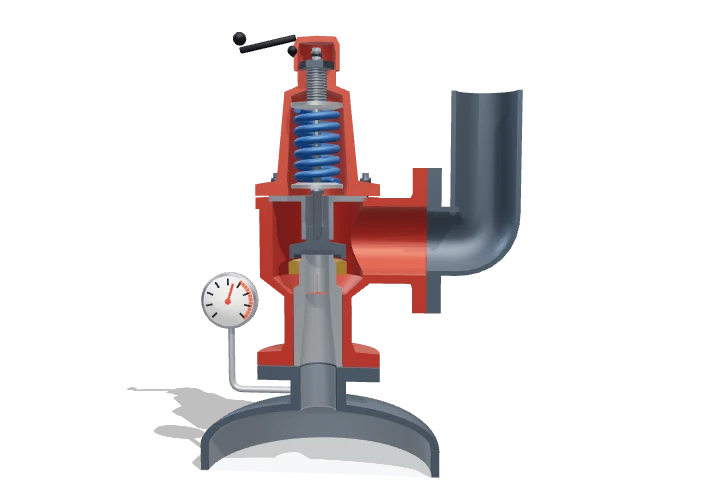 Open the interactive 3D model →
What stops a boiler full of steam from exploding if its controls fail?
A pressure relief valve is a spring-loaded plug on top of a pressure vessel. Normally the spring holds the plug shut, but if the pressure inside gets too high it pushes the plug up and steam rushes out. Once the pressure has dropped safely, the spring snaps it shut again.
A spring-loaded safety relief valve is the last line of defence against overpressure: when vessel pressure on the disc overcomes the spring pre-load, the valve opens and discharges enough fluid to stop the pressure rising. Its design makes it snap open at the set pressure, reach full capacity within a small permitted overpressure, and reseat only after the pressure has fallen by the blowdown.
Key facts
- Set pressure (model)
- 10 barg
- Orifice (model)
- API 526 "J": 830 mm² (1.287 in²), bore ≈ 32.5 mm
- Allowed accumulation (single valve, non-fire)
- 10 % of MAWP (ASME VIII / ISO 4126 practice)
- Typical blowdown
- ≈ 2–10 % of set (model: 7 %)
- Full lift
- ≈ ¼ of nozzle bore (curtain area = bore area)
- Rated capacity (model, 10 % over)
- ≈ 5,100 kg/h saturated steam
Parts you can explore (15)
- Pressure vessel
- Pressure gauge
- Inlet nozzle
- Blowdown ring
- Disc and holder
- Guide
- Spindle
- Spring washers
- Spring
- Adjusting screw
- Bonnet
- Valve body
- Outlet and tailpipe
- Cap and lifting lever
- Steam discharge
In the 3D model
Rotate and take apart the model, follow a guided tour of what each part does and why it’s needed, change it with a live slider, and test yourself with a short quiz. Free, no sign-up.
Open Pressure relief valve in 3D →
OpenArc Models’ models are simplified teaching schematics. Terms · Privacy