Fluids & heat
Pressure cooker
Thermodynamics · Phase change
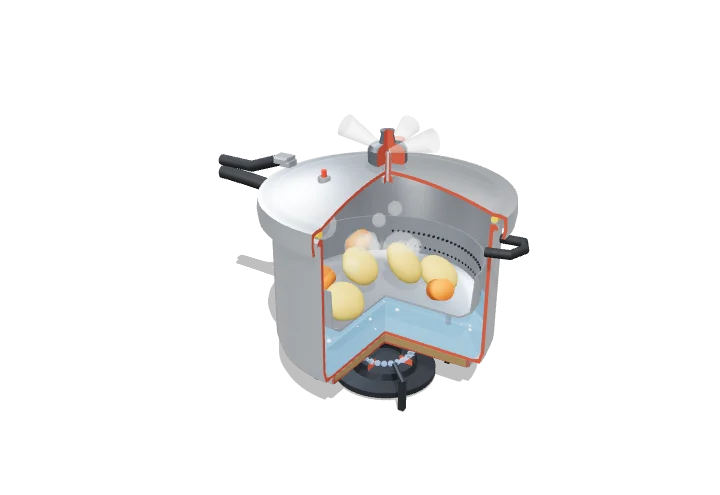 Open the interactive 3D model →
Why do beans that take two hours in a pan cook in half an hour in a pressure cooker?
In an open pan, water can never get hotter than 100 °C, because it just boils away. A pressure cooker seals the steam in, and the squeezed steam makes the water boil only at about 120 °C. Hotter water cooks food about three times faster.
A pressure cooker traps steam so the pressure inside rises to about one atmosphere above ambient, which raises the boiling point of water from 100 °C to about 120 °C. A weighted vent fixes that pressure, a gasket and bayonet lid hold it in, and back-up valves make sure it can never be exceeded or released while the lid is open.
Key facts
- Regulator setting (stovetop)
- ≈ +100 kPa gauge (15 psi), ≈ 201 kPa absolute
- Boiling point at that pressure
- ≈ 120 °C (steam tables 120.2 °C at 198.5 kPa)
- Regulator weight on a 3.5 mm vent
- ≈ 100 g (mg = Δp·A)
- Upward force on a 220 mm lid at +100 kPa
- ≈ 3.8 kN (≈ 390 kg weight)
- Typical cooking-time reduction
- ≈ 3–4× versus boiling at 100 °C
- Electric multicookers
- ≈ +70–80 kPa, boiling ≈ 115–117 °C
Parts you can explore (13)
- Pot body
- Encapsulated base
- Lid
- Gasket
- Vent pipe
- Pressure regulator weight
- Safety valve
- Locking float valve
- Handles
- Water
- Food and steamer basket
- Steam
- Burner and flame
In the 3D model
Rotate and take apart the model, follow a guided tour of what each part does and why it’s needed, change it with a live slider, and test yourself with a short quiz. Free, no sign-up.
OpenArc Models’ models are simplified teaching schematics. Terms · Privacy