Fluids & heat
Hydraulic press
Fluid power · Pascal’s principle
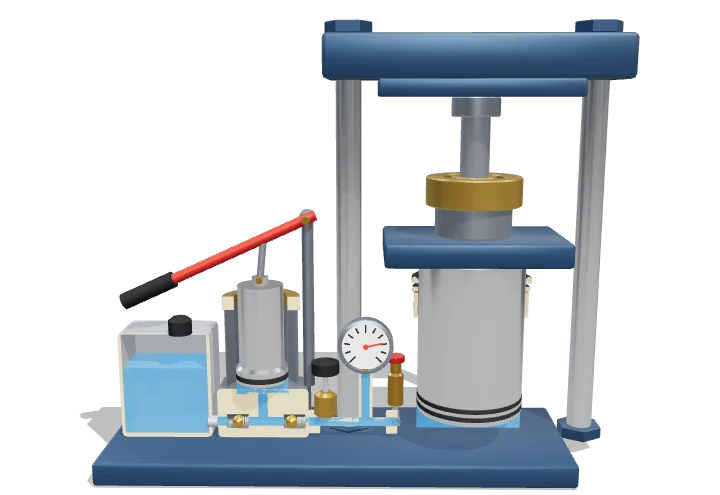 Open the interactive 3D model →
How can one person’s arm push with the force of a two-tonne weight?
A hydraulic press is filled with oil, which hardly squashes at all. Pushing a small piston raises the oil’s pressure, and that same pressure pushes on a much bigger piston, the ram. Bigger area means bigger force — but the ram moves only a little way for each push.
A hydraulic press uses an enclosed, nearly incompressible liquid to transmit pressure undiminished from a small piston to a large ram, multiplying force by the area ratio A₂/A₁. Energy is conserved, so the ram moves only A₁/A₂ as far as the input piston, and real presses lose a few per cent to seal friction, leakage and fluid compressibility.
Key facts
- Force multiplication (ideal)
- F₂/F₁ = A₂/A₁ (model: 2–16×)
- Travel ratio (ideal)
- d₂/d₁ = A₁/A₂
- Model ram
- 90 mm diameter, A₂ = 63.6 cm²; 20 kN load → 3.1 MPa
- Typical working pressure
- Industrial 10–35 MPa; hand pumps and tools up to 70 MPa (700 bar)
- Mineral-oil bulk modulus
- ≈ 1.4–1.8 GPa (much lower with entrained air)
- Mechanical efficiency
- ≈ 90–98% (seal friction and leakage)
Parts you can explore (12)
- Input piston
- Pump handle
- Output ram
- Cylinders & fluid
- Check valves
- Fluid reservoir
- Pressure line
- Pressure gauge
- Release & relief valves
- Ram seals & wiper
- Frame & platen
- Workpiece
In the 3D model
Rotate and take apart the model, follow a guided tour of what each part does and why it’s needed, change it with a live slider, and test yourself with a short quiz. Free, no sign-up.
OpenArc Models’ models are simplified teaching schematics. Terms · Privacy