Chemistry
Polymer chains
Polymer chemistry · Structure & morphology
 Open the interactive 3D model →
How can the same chain of carbon atoms make both a floppy carrier bag and bulletproof body armour?
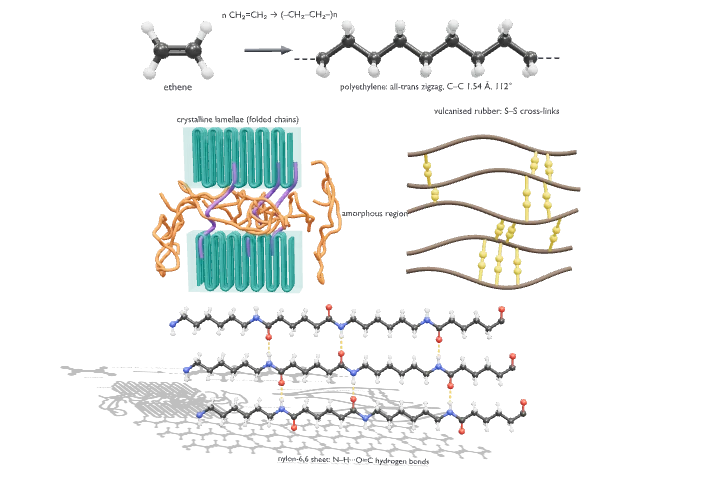
A polymer is a giant molecule made by linking thousands of small molecules into a long chain. Polyethylene, the most common plastic, is just carbon and hydrogen repeated over and over. What makes a plastic soft, stiff, stretchy or strong is mostly how its chains are arranged: neatly folded, tangled, tied together or stuck side by side.
Polymers are long chains of repeating units, such as polyethylene made by joining thousands of ethene molecules, and their properties depend as much on how the chains are arranged as on their chemistry. Chains can fold into crystalline lamellae, tangle into amorphous regions whose mobility switches on at the glass transition, be tied into networks by cross-links, or be stitched into sheets by hydrogen bonds as in nylon-6,6.
Key facts
- Polyethylene repeat unit
- –CH₂–CH₂–, 28.05 g/mol
- Backbone geometry
- C–C 1.54 Å, C–C–C ≈ 112°, 2.55 Å rise per repeat
- HDPE crystallinity
- ≈ 60–80% (LDPE ≈ 40–50%)
- Polyethylene Tg / Tm
- ≈ −120 °C / ≈ 130–137 °C (HDPE)
- Nylon-6,6 Tg / Tm
- ≈ 50 °C / ≈ 265 °C
- Lamella thickness
- ≈ 10–20 nm
Parts you can explore (9)
- Ethene monomer
- Polyethylene chain
- Crystalline lamellae
- Amorphous tangle
- Tie molecules
- Cross-linked network (vulcanised)
- Sulfur cross-links
- Nylon-6,6 hydrogen-bonded sheet
- Amide hydrogen bonds
In the 3D model
Rotate and take apart the model, follow a guided tour of what each part does and why it’s needed, change it with a live slider, and test yourself with a short quiz. Free, no sign-up.
OpenArc Models’ models are simplified teaching schematics. Terms · Privacy