Physics
Polarization of light
Wave optics · Polarization
 Open the interactive 3D model →
How do polarising sunglasses cut glare — and why can they turn a phone screen black?
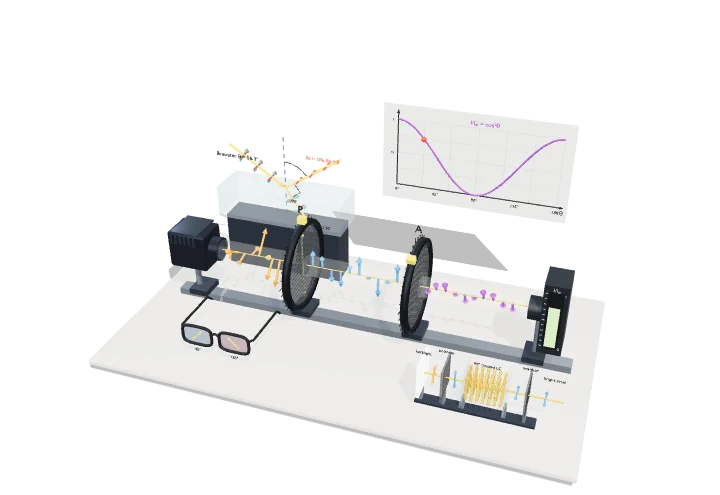
Light is a wave whose electric field wiggles from side to side as it travels. In ordinary light the wiggle points in every direction at random. A polarising filter only lets through the part wiggling in one direction, and a second filter turned across the first can block the light completely.
Light is a transverse electromagnetic wave, and polarisation describes the direction in which its electric field oscillates; a polariser transmits only the field component along its axis. Passing polarised light through a second polariser at angle θ leaves an intensity I = I₀cos²θ (Malus’s law), a principle exploited in glare-cutting sunglasses, 3D cinema and every liquid-crystal display.
Key facts
- Malus’s law
- I = I₀cos²θ
- Ideal polariser on unpolarised light
- Transmits 50% of the intensity
- Brewster’s angle
- tanθ_B = n₂/n₁ (56.3° for n = 1.50 glass, 53.1° for water)
- Reflected s-intensity at θ_B (glass)
- Rs ≈ 15%, Rp = 0
- LCD twist (TN cell)
- 90° across a ~5 µm layer
- Model scale
- Wavelength drawn ~10⁶× real; field oscillation slowed ~10¹⁵×
Parts you can explore (12)
- Optical bench
- Unpolarised lamp
- Unpolarised light
- Polariser
- Polarised light
- Analyser
- Transmitted light
- Light meter
- Malus's law graph
- Brewster-angle reflection
- 3D glasses
- LCD pixel
In the 3D model
Rotate and take apart the model, follow a guided tour of what each part does and why it’s needed, change it with a live slider, and test yourself with a short quiz. Free, no sign-up.
Open Polarization of light in 3D →
OpenArc Models’ models are simplified teaching schematics. Terms · Privacy