Fluids & heat
Plate heat exchanger
Heat transfer · Heat exchangers
 Open the interactive 3D model →
How does a dairy heat milk with hot water without the two ever mixing?
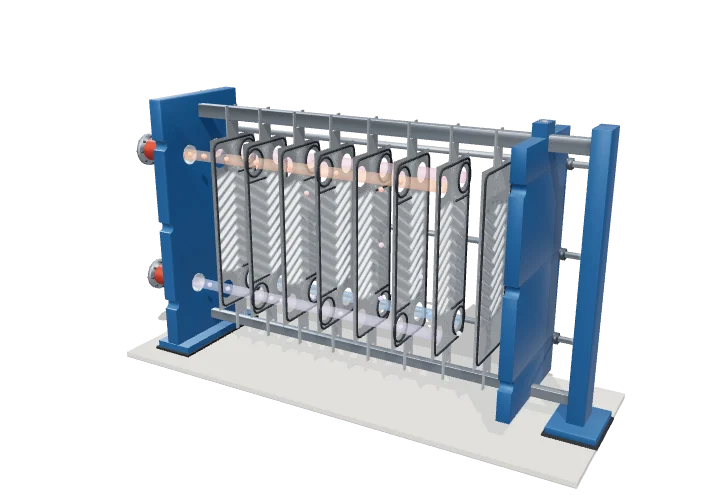
A plate heat exchanger is a stack of thin, wavy metal sheets clamped together. Hot liquid flows through every other gap and cold liquid through the gaps in between, so each sheet has hot on one side and cold on the other. Heat passes through the thin metal, but the liquids never touch.
A gasketed plate heat exchanger transfers heat between two liquids through a stack of thin, corrugated metal plates whose gaskets route the hot and cold streams into alternate narrow channels. Counter-flow and the turbulence created by chevron corrugations give very high heat-transfer coefficients, so a compact, easily opened unit can do the work of a much larger shell-and-tube exchanger.
Key facts
- Plate thickness
- ≈ 0.4–0.8 mm stainless steel or titanium
- Channel gap
- ≈ 2–5 mm
- Chevron angle
- ≈ 25–65° to the flow direction
- Overall U (water–water)
- ≈ 3,000–7,000 W m⁻² K⁻¹
- Temperature approach
- down to ≈ 1–2 K
- Typical limits
- ≈ 25 bar, ≈ 150–180 °C (set by the gaskets)
Parts you can explore (11)
- Heat-transfer plates
- Gaskets
- Fixed frame plate
- Port nozzles
- Pressure plate
- Carrying bar
- Guide bar
- Support column
- Tie bolts
- Hot stream
- Cold stream
In the 3D model
Rotate and take apart the model, follow a guided tour of what each part does and why it’s needed, change it with a live slider, and test yourself with a short quiz. Free, no sign-up.
Open Plate heat exchanger in 3D →
OpenArc Models’ models are simplified teaching schematics. Terms · Privacy