Earth & space
Plate boundaries
Plate tectonics · Lithosphere
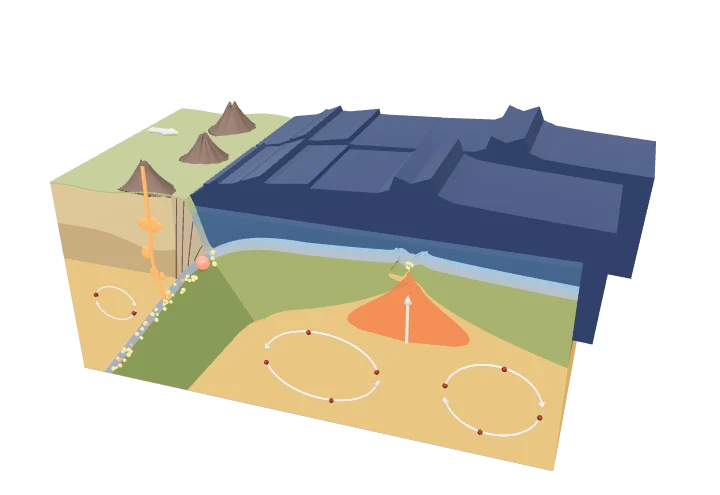 Open the interactive 3D model →
If the ground under your feet is moving a few centimetres a year, where is it all going?
Earth’s hard outer shell is cracked into giant pieces called plates that slowly move, about as fast as your fingernails grow. Where plates pull apart, new sea floor is made; where they push together, one dives under the other; and where they slide past, the ground jerks sideways. Almost all earthquakes and volcanoes happen along these edges.
Earth’s rigid lithosphere is broken into plates that move a few centimetres per year over the weak asthenosphere, and almost all earthquakes, volcanoes and mountain belts sit at their boundaries. Plates separate at mid-ocean ridges, converge at subduction zones and slide past one another at transform faults, and each boundary type has its own signature of topography, magmatism and seismicity.
Key facts
- Plate speeds
- ≈ 2–10 cm/yr (fingernail growth ≈ 4 cm/yr)
- Oceanic crust thickness
- ≈ 6–7 km
- Lithosphere thickness
- ~0 km at ridge → ~100 km (old ocean); 100–250 km under cratons
- Oldest seafloor
- ≈ 180–200 Myr (western Pacific)
- Deepest earthquakes
- ≈ 700 km, in subducting slabs
- Major plates
- 7 large + ~8 medium and many microplates
Parts you can explore (15)
- Ocean water
- Oceanic crust
- Lithospheric mantle
- Continental crust
- Asthenosphere
- Mid-ocean ridge
- Upwelling magma
- Subducting slab
- Ocean trench
- Volcanic arc
- Earthquake foci
- Transform fault
- Mantle convection
- Magnetic stripes
- Plate motion
In the 3D model
Rotate and take apart the model, follow a guided tour of what each part does and why it’s needed, change it with a live slider, and test yourself with a short quiz. Free, no sign-up.
OpenArc Models’ models are simplified teaching schematics. Terms · Privacy