Plants & animals
Plant stem
Plant biology · Stem anatomy & transport
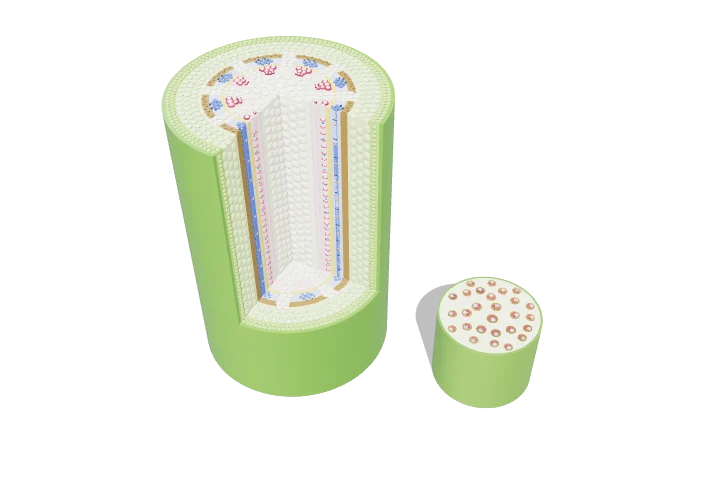 Open the interactive 3D model →
How does a tree lift water 100 metres into the air without a heart or a single pump?
A plant stem is full of two kinds of tiny pipes. One kind, the xylem, carries water up from the roots, pulled from above as water evaporates from the leaves. The other kind, the phloem, carries sugar made in the leaves to the roots, fruits and growing tips.
A young dicot stem is organised as concentric tissues — epidermis, cortex, a ring of vascular bundles and a central pith — while monocot stems scatter their bundles through ground tissue. Its xylem carries water upward under tension generated by transpiration, and its phloem carries sugar from sources to sinks by osmotically generated pressure flow.
Key facts
- Xylem vessel diameter
- ≈ 20–500 µm (narrow in herbs, widest in ring-porous trees)
- Xylem sap velocity
- ≈ 1–6 m/h in many trees; > 40 m/h in some ring-porous species
- Phloem sap velocity
- ≈ 0.5–1 m/h (typical range 0.3–1.5 m/h)
- Phloem sap sucrose
- ≈ 0.3–0.9 M (10–25% w/v)
- Xylem tension in transpiring plants
- ≈ −0.5 to −3 MPa (lower in drought)
- Sieve-element pressure
- ≈ +0.5 to +2 MPa
Parts you can explore (12)
- Epidermis
- Collenchyma
- Cortex
- Sclerenchyma cap
- Phloem sieve tubes
- Companion cells
- Vascular cambium
- Xylem vessels
- Pith
- Xylem sap
- Phloem sap
- Monocot stem (inset)
In the 3D model
Rotate and take apart the model, follow a guided tour of what each part does and why it’s needed, change it with a live slider, and test yourself with a short quiz. Free, no sign-up.
OpenArc Models’ models are simplified teaching schematics. Terms · Privacy