Cells & molecules
Plant cell
Cell biology · Eukaryotic cell
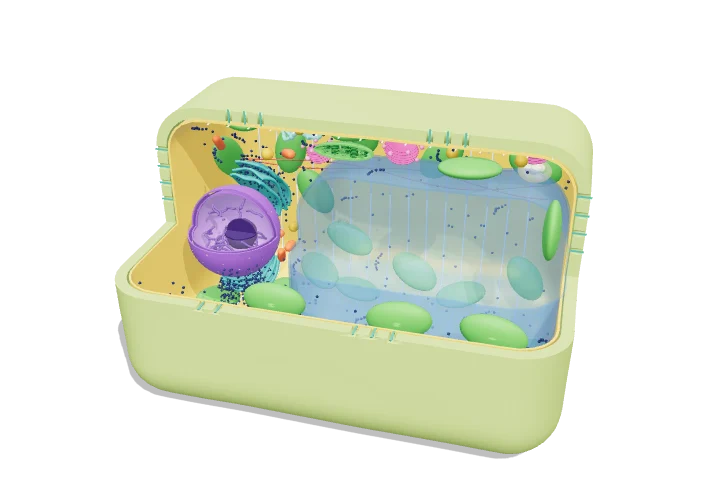 Open the interactive 3D model →
How does a plant with no bones or muscles hold its leaves up to the sun?
Each plant cell is like a water balloon inside a strong cardboard box. A huge bag of watery sap, the vacuole, swells and presses hard against the box, the cell wall, which makes the cell firm. Packed around the edge are green chloroplasts that use sunlight to make sugar.
A plant cell is a eukaryotic cell enclosed by a rigid, porous wall, with a large central vacuole and plastids such as chloroplasts. Osmotic water uptake into the vacuole pressurises the protoplast against the wall, and this turgor pressure both supports the plant and drives cell expansion.
Key facts
- Typical size
- ≈ 10–100 µm; leaf mesophyll cells ≈ 20–50 µm
- Central vacuole
- Often ≈ 80–90% of the volume of a mature cell
- Chloroplasts per mesophyll cell
- Tens to ≈ 100, depending on species and cell size
- Primary wall thickness
- ≈ 0.1–1 µm
- Turgor pressure
- ≈ 0.3–1 MPa in typical tissues (3–10 × car-tyre pressure)
- Plasmodesma diameter
- ≈ 40–50 nm; passes molecules up to ≈ 1 kDa freely
Parts you can explore (14)
- Cell wall
- Plasma membrane
- Central vacuole
- Nucleus
- Nucleolus
- Chloroplasts
- Mitochondria
- Rough ER
- Smooth ER
- Golgi apparatus
- Ribosomes
- Peroxisomes
- Cytoskeleton
- Amyloplasts
In the 3D model
Rotate and take apart the model, follow a guided tour of what each part does and why it’s needed, change it with a live slider, and test yourself with a short quiz. Free, no sign-up.
OpenArc Models’ models are simplified teaching schematics. Terms · Privacy