Mechanisms
Planetary gearbox
Power transmission · 4 : 1 epicyclic
 Open the interactive 3D model →
How do robot arms, wind turbines and car gearboxes fit a big gear reduction into a small round case?
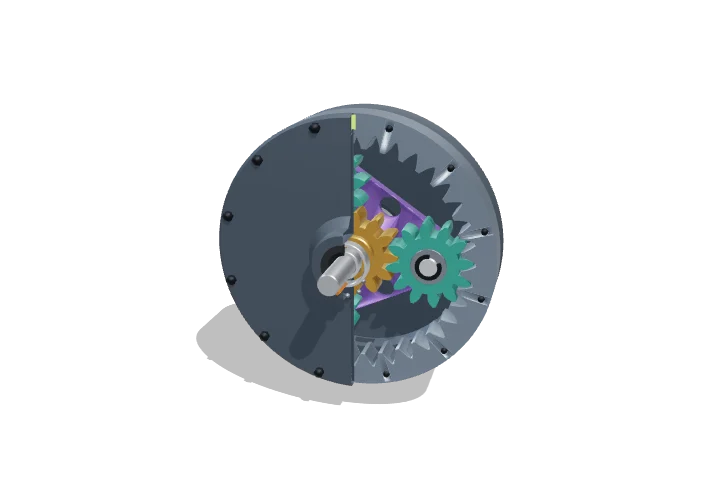
A planetary gearbox puts gears inside a gear. A small sun gear in the middle turns three planet gears, which roll around inside a fixed ring with teeth on its inside. The frame holding the planets turns four times slower than the sun, with about four times the turning force.
A planetary (epicyclic) gearset has a sun gear, planet gears on a rotating carrier and an internal ring gear, all sharing one axis. With the ring held and the sun driving, this 12/12/36-tooth set turns the carrier at one quarter of sun speed, giving a compact, coaxial 4:1 reduction with the load shared among three planets.
Key facts
- Ratio (ring fixed, sun in, carrier out)
- 1 + Z_r/Z_s = 1 + 36/12 = 4 : 1
- Tooth counts (model)
- Sun 12, planets 12 × 3, ring 36 (module 3.6 mm, 25° pressure angle)
- Geometric condition
- Z_r = Z_s + 2Z_p
- Single-stage ratio range
- ≈ 3 : 1 to 10 : 1 (simple sun–planet–ring)
- Efficiency per stage
- ≈ 97–99%
- Degrees of freedom
- 2 — fix one member to get a single ratio
Parts you can explore (12)
- Sun gear (12T)
- Input shaft
- Planet gears (12T)
- Planet pins & needle bearings
- Carrier
- Output shaft
- Ring gear (36T, fixed)
- Gearbox end covers
- Ring mounting fasteners
- Input bearing
- Output bearing
- Shaft seals
In the 3D model
Rotate and take apart the model, follow a guided tour of what each part does and why it’s needed, change it with a live slider, and test yourself with a short quiz. Free, no sign-up.
Open Planetary gearbox in 3D →
OpenArc Models’ models are simplified teaching schematics. Terms · Privacy