Human body
Placenta and fetus
Anatomy · Pregnancy
 Open the interactive 3D model →
How does a baby breathe and eat for nine months without ever taking a breath or a bite?
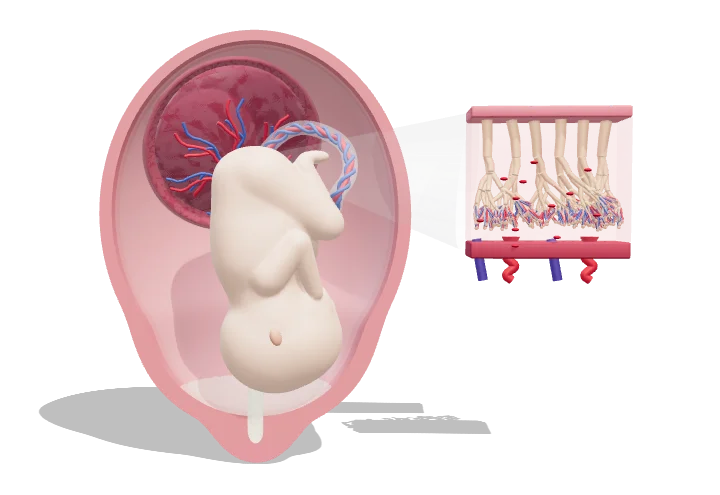
Before birth, a baby gets everything through the placenta, a temporary organ attached to the inside of the womb. The baby’s blood flows along the umbilical cord into tiny branches in the placenta, where it picks up oxygen and food from the mother’s blood and drops off waste. The two bloods sit side by side but never mix.
The placenta is a temporary organ, built from fetal chorion and maternal decidua, that lets the fetus exchange gases, nutrients and wastes with maternal blood without the two circulations mixing. The fetus grows inside the fluid-filled amniotic sac, connected to the placenta by an umbilical cord with two arteries and one vein.
Key facts
- Placenta at term
- ≈ 15–22 cm diameter, 2–3 cm thick, ≈ 500 g
- Umbilical cord at term
- ≈ 50–60 cm long, ≈ 1–2 cm thick
- Villous surface area
- ≈ 10–14 m² at term
- Placental barrier thickness
- ≈ 2–4 µm at term (vs ≈ 20–30 µm early)
- Uteroplacental blood flow
- ≈ 500–700 mL/min at term
- Amniotic fluid
- ≈ 800 mL at 28–34 weeks; declines toward term
Parts you can explore (13)
- Uterine wall
- Cervix & mucus plug
- Decidua basalis
- Placenta
- Umbilical cord
- Umbilical arteries
- Umbilical vein
- Amniotic sac
- Amniotic fluid
- Fetus
- Chorionic villi (inset)
- Intervillous space (inset)
- Spiral arteries (inset)
In the 3D model
Rotate and take apart the model, follow a guided tour of what each part does and why it’s needed, change it with a live slider, and test yourself with a short quiz. Free, no sign-up.
Open Placenta and fetus in 3D →
OpenArc Models’ models are simplified teaching schematics. Terms · Privacy