Fluids & heat
Pitot-static tube and airspeed indicator
Aerodynamics · Flight instruments
 Open the interactive 3D model →
How does a plane know its speed when there is no road to measure against?
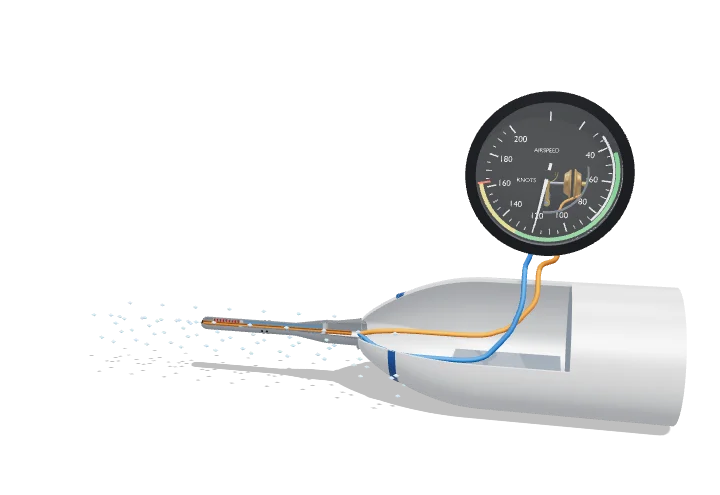
A pitot tube is a small pipe sticking forward into the wind. Air rams into the hole at its tip and pushes harder the faster the plane flies, while holes on its side feel only the normal air pressure. A gauge in the cockpit compares the two pressures and turns the difference into a speed reading.
A pitot-static probe measures the total pressure of the oncoming air at its tip and the static pressure at side ports; by Bernoulli’s equation their difference is the dynamic pressure q = ½ρv². The airspeed indicator is a differential pressure gauge for q, calibrated assuming sea-level air density, so at altitude it reads less than the true airspeed.
Key facts
- Measured quantity
- Dynamic pressure q = p_total − p_static = ½ρv²
- q at 120 kt, sea level
- ≈ 2.33 kPa (≈ 2.3 % of static pressure)
- ISA density
- 1.225 kg/m³ at sea level; 1.056 at 5,000 ft; 0.905 at 10,000 ft
- TAS vs IAS rule of thumb
- TAS ≈ IAS + 2 % per 1,000 ft
- Pitot tube invented
- Henri Pitot, 1732
- Incompressible formula valid
- Up to about Mach 0.3
Parts you can explore (13)
- Fuselage nose
- Pitot-static probe
- Total pressure port
- Static ports
- Probe heater
- Pitot line
- Static line
- Airspeed indicator case
- Diaphragm capsule
- Rocking shaft and sector
- Pinion and needle
- Dial
- Airflow tracers
In the 3D model
Rotate and take apart the model, follow a guided tour of what each part does and why it’s needed, change it with a live slider, and test yourself with a short quiz. Free, no sign-up.
Open Pitot-static tube and airspeed indicator in 3D →
OpenArc Models’ models are simplified teaching schematics. Terms · Privacy