Mechanisms
Pin-tumbler lock
Mechanisms · Locks
 Open the interactive 3D model →
Why does only your own key open your front door, when a friend’s key looks almost the same?
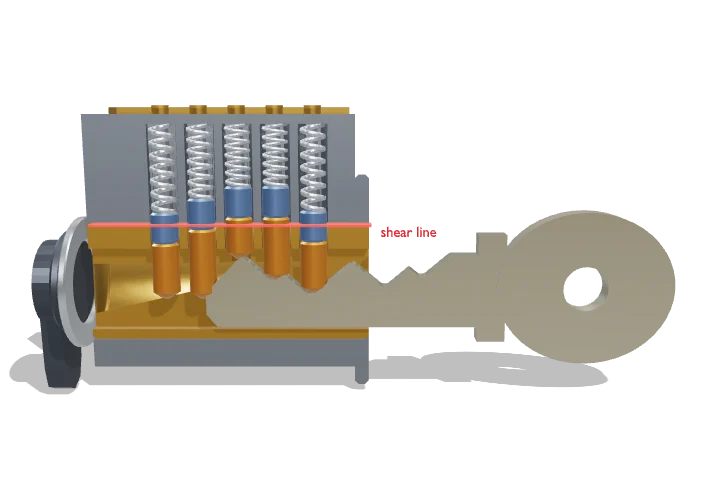
Inside a door lock, little stacks of metal pins poke across the line between the part that turns and the part that stays still, so nothing can turn. Each stack is split in two at a different height. The right key lifts every stack by just the right amount, so all the splits line up exactly on that line — and the lock can turn.
A pin-tumbler lock keeps its plug from turning with stacks of pins that straddle the shear line between plug and housing. The correct key lifts each stack by exactly the right amount so that every gap between a key pin and its driver pin lies on the shear line, and the plug is free to rotate.
Key facts
- Plug diameter
- 12.7 mm (0.500 in) — common in North American cylinders
- Pin diameter
- ≈ 2.9 mm (0.115 in)
- Pin spacing
- ≈ 3.96 mm (0.156 in) centre to centre
- Depth increment (Schlage)
- 0.381 mm (0.015 in), 10 depths
- Theoretical key differs
- 10⁵ = 100 000 for 5 pins × 10 depths
- Pins in this model
- 5 stacks: key pin + driver pin + spring
Parts you can explore (9)
- Housing
- Plug
- Key pins
- Driver pins
- Springs
- Key
- Shear line
- Cam and retainer
- Chamber cover
In the 3D model
Rotate and take apart the model, follow a guided tour of what each part does and why it’s needed, change it with a live slider, and test yourself with a short quiz. Free, no sign-up.
OpenArc Models’ models are simplified teaching schematics. Terms · Privacy