Physics
Photoelectric effect
Quantum physics · Photons
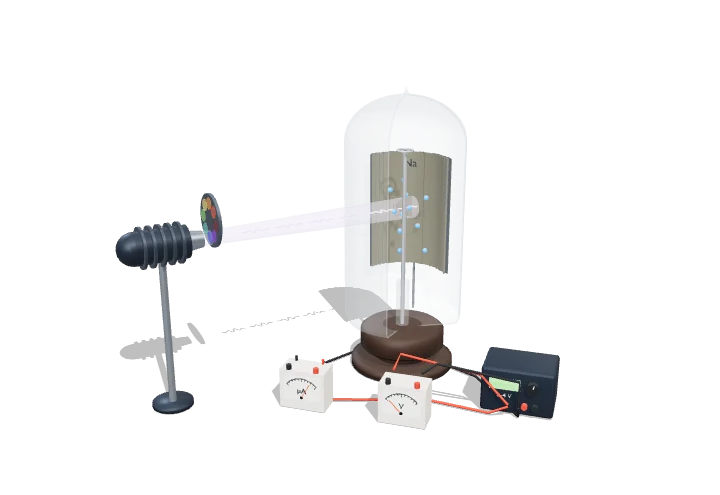 Open the interactive 3D model →
Why can a dim violet light knock electrons out of a metal when a blinding red light cannot?
Light arrives in tiny packets of energy called photons, and the colour of light sets how much energy each packet carries. To knock an electron out of a metal, a single photon must carry enough energy on its own. Making red light brighter only adds more weak packets, so it still frees no electrons.
When light of high enough frequency strikes a metal, electrons are emitted with a maximum kinetic energy that depends on the frequency, not the intensity, of the light. Einstein explained this in 1905 by treating light as photons of energy hf, giving KE_max = hf − φ, which a stopping-voltage measurement confirms and which yields Planck’s constant.
Key facts
- Planck constant
- h = 6.626 × 10⁻³⁴ J s = 4.136 × 10⁻¹⁵ eV s
- Sodium work function
- φ ≈ 2.28 eV (literature 2.3–2.4 eV)
- Sodium threshold
- f₀ = φ/h ≈ 5.5 × 10¹⁴ Hz (λ₀ ≈ 544 nm)
- Stopping voltage at 8 × 10¹⁴ Hz
- V_s = (hf − φ)/e ≈ 1.03 V
- Slope of V_s versus f
- h/e = 4.14 × 10⁻¹⁵ V s
- Emission delay
- less than about 10⁻⁹ s
Parts you can explore (12)
- Glass envelope
- Tube base
- Metal cathode
- Anode
- Photoelectrons
- Light source
- Light beam
- Photons
- Microammeter
- Voltmeter
- Retarding-voltage supply
- Circuit wires
In the 3D model
Rotate and take apart the model, follow a guided tour of what each part does and why it’s needed, change it with a live slider, and test yourself with a short quiz. Free, no sign-up.
Open Photoelectric effect in 3D →
OpenArc Models’ models are simplified teaching schematics. Terms · Privacy