Fluids & heat
Peristaltic pump
Fluid handling · Positive-displacement pump
 Open the interactive 3D model →
How can a hospital pump move blood for hours without the blood ever touching the pump’s machinery?
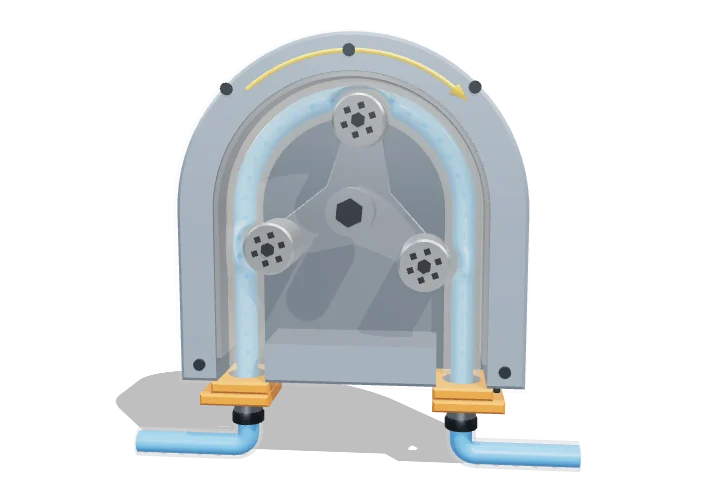
A peristaltic pump has rollers that squeeze a soft tube flat and roll along it, pushing the liquid ahead of them. Behind each roller the tube springs back open and sucks in more liquid. The liquid only ever touches the inside of the tube, so it stays clean.
A peristaltic pump moves liquid by rolling a pinch point along a flexible tube pressed against a curved track, so slugs of liquid trapped between rollers are pushed from inlet to outlet. Because the liquid touches only the tube, and flow is set by tube size and rotor speed, these pumps are the standard choice for sterile, corrosive, viscous and precisely metered fluids.
Key facts
- Tube (this model)
- 4.8 mm bore × 1.6 mm wall, silicone
- Ideal displacement (this model)
- ≈ 2.7 mL per rotor revolution
- Typical tube-pump flows
- ≈ µL/min (lab) to ≈ 10 L/min
- Typical discharge pressure
- ≈ 1–2 bar tube pumps; up to ≈ 15 bar hose pumps
- Rollers
- Usually 2–12; 3 here
- Self-priming suction lift
- Up to ≈ 8–9 m of water (tube dependent)
Parts you can explore (12)
- Pump head housing
- Occlusion bed
- Rotor
- Rollers
- Flexible tube
- Fluid slugs
- Tube clamps
- Inlet line
- Outlet line
- Drive motor
- Clear cover
- Flow tracers
In the 3D model
Rotate and take apart the model, follow a guided tour of what each part does and why it’s needed, change it with a live slider, and test yourself with a short quiz. Free, no sign-up.
OpenArc Models’ models are simplified teaching schematics. Terms · Privacy