Plants & animals
Paramecium
Protists · Ciliate
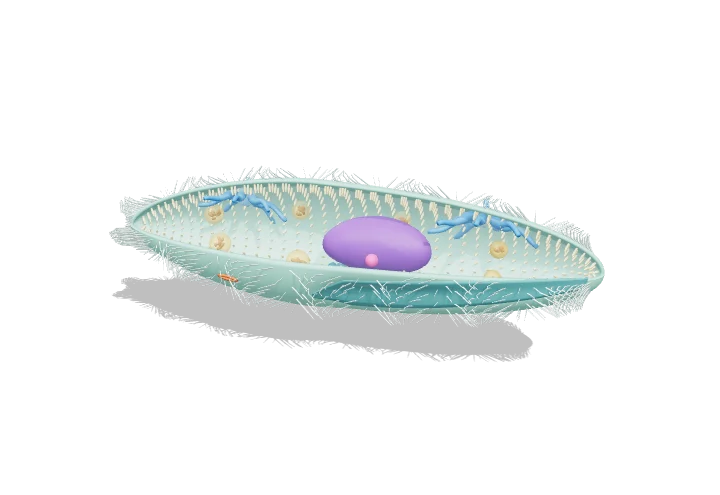 Open the interactive 3D model →
How does a single cell with no brain, mouth or muscles swim, eat and avoid bumping into things?
Paramecium is one cell, about a quarter of a millimetre long, that lives in ponds. It is covered in thousands of tiny hairs called cilia that beat like oars to make it swim, and it sweeps bacteria into a mouth-like groove to eat them. Inside, it has its own stomach bubbles, a water pump and even two kinds of nucleus.
Paramecium caudatum is a single-celled ciliate that swims, feeds, digests, excretes and osmoregulates using specialised organelles rather than tissues. Its thousands of coordinated cilia, two kinds of nucleus and pumping contractile vacuoles make it a classic model for cell biology, behaviour and ecology.
Key facts
- Cell length
- ≈ 170–300 µm (P. caudatum)
- Cilia
- ≈ 4,000–5,000, each ~10 µm long
- Beat frequency
- ≈ 15–30 Hz (forward swimming)
- Swimming speed
- ≈ 0.5–1 mm/s (several body lengths per second)
- Nuclei
- 1 polyploid macronucleus + 1 diploid micronucleus
- Contractile vacuole cycle
- ≈ 5–20 s, depending on external osmolarity
Parts you can explore (11)
- Pellicle
- Cilia
- Oral groove
- Cytostome
- Food vacuoles
- Contractile vacuoles
- Macronucleus
- Micronucleus
- Trichocysts
- Anal pore
- Endoplasm
In the 3D model
Rotate and take apart the model, follow a guided tour of what each part does and why it’s needed, change it with a live slider, and test yourself with a short quiz. Free, no sign-up.
OpenArc Models’ models are simplified teaching schematics. Terms · Privacy