Mechanisms
Drafting pantograph
Mechanisms · Linkages
 Open the interactive 3D model →
How can four wooden sticks copy any drawing exactly twice as big — with no measuring at all?
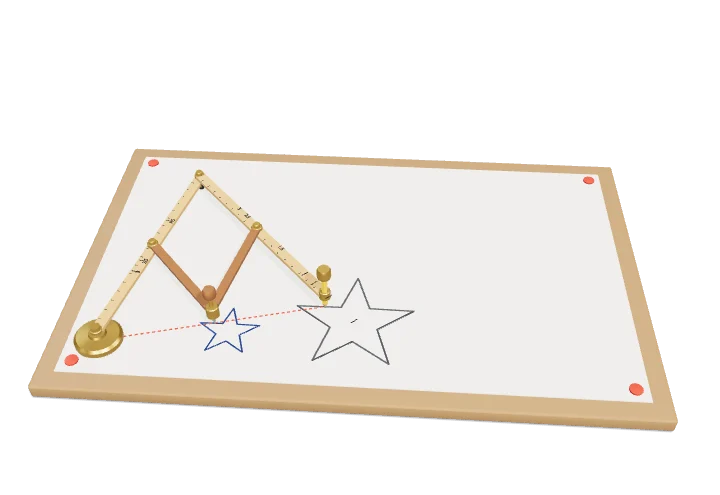
A pantograph is four bars pinned together into a hinged parallelogram, with one end fixed to the table. You run a pointer around a small picture and a pencil further along the bars draws the same picture, only bigger. The pointer, the fixed pin and the pencil always stay in one straight line, so every distance is multiplied by the same amount.
A pantograph is a four-bar linkage arranged as a parallelogram with one point pinned to the drawing surface, so that a tracing point and a pencil point always lie on a straight line through the pivot. Because the ratio of their distances from the pivot is fixed by where the bars are pinned, the pencil draws a scaled copy — an enlargement or reduction — of whatever the tracer follows.
Key facts
- Defining relation
- P − O = k (T − O): a homothety (central dilation) with centre O
- Scale factor
- k = OP/OT = L/OC, set by pinning C and D at L/k along the arms
- Model range
- k = 1.5 to 3 (arm length L ≈ 47 cm)
- Lengths and areas
- lengths × k, areas × k², angles unchanged
- Degrees of freedom
- 2 (the tracer can move anywhere in its reachable region)
- Invented
- Christoph Scheiner, c. 1603–1631
Parts you can explore (12)
- Drawing board
- Fixed pivot
- Pivot arm
- Pencil arm
- Tracer link
- Connecting link
- Tracer stylus
- Pencil holder
- Support caster
- Original figure
- Enlarged copy
- Collinearity line
In the 3D model
Rotate and take apart the model, follow a guided tour of what each part does and why it’s needed, change it with a live slider, and test yourself with a short quiz. Free, no sign-up.
Open Drafting pantograph in 3D →
OpenArc Models’ models are simplified teaching schematics. Terms · Privacy