Human body
Pancreatic islet
Anatomy · Endocrine & digestive · Histology
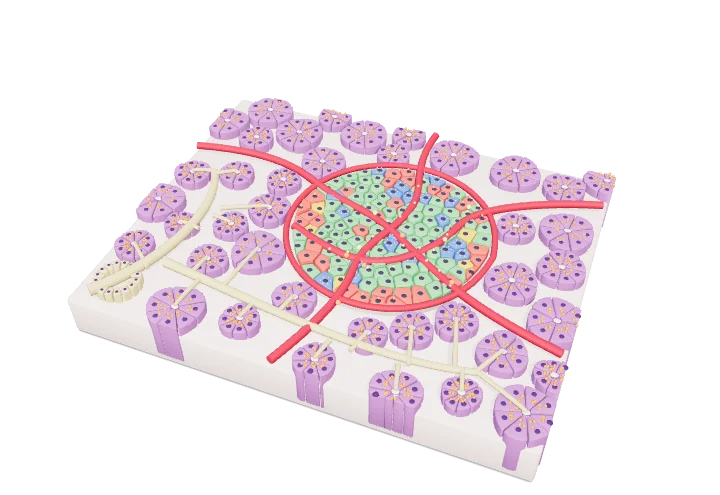 Open the interactive 3D model →
How does your body know to lower your blood sugar after a slice of cake?
Your pancreas is really two organs in one. Most of it makes digestive juices that flow into your gut, but tiny islands of cells scattered through it act as sugar sensors. When blood sugar rises they release insulin, and when it falls they release glucagon.
The pancreas is a mixed gland: acini secrete digestive enzymes into ducts, while islets of Langerhans secrete hormones into the blood. Within each islet, β cells release insulin when glucose rises and α cells release glucagon when it falls, keeping fasting plasma glucose at about 4–6 mmol/L.
Key facts
- Islets per human pancreas
- ≈ 1–3 million (estimates vary widely)
- Endocrine fraction
- ≈ 1–2% of pancreatic mass
- Islet diameter
- ≈ 50–300 µm; ~1,000–3,000 cells in a typical islet
- Human islet composition
- β ≈ 50–70%, α ≈ 20–40%, δ ≈ 5–10%, PP < 5%
- Normal fasting glucose
- ≈ 3.9–5.6 mmol/L (70–100 mg/dL)
- Pancreatic juice
- ≈ 1–1.5 L/day, pH ≈ 8
Parts you can explore (12)
- Acinar cells
- Zymogen granules
- Pancreatic ducts
- β cells
- α cells
- δ cells
- PP cells
- Capillaries
- Insulin granules
- Glucagon granules
- Centroacinar cells
- Connective tissue stroma
In the 3D model
Rotate and take apart the model, follow a guided tour of what each part does and why it’s needed, change it with a live slider, and test yourself with a short quiz. Free, no sign-up.
OpenArc Models’ models are simplified teaching schematics. Terms · Privacy