Physics
Organ pipes and standing waves
Waves · Acoustics
 Open the interactive 3D model →
Why does putting a cap on the end of an organ pipe make it sing a whole octave lower?
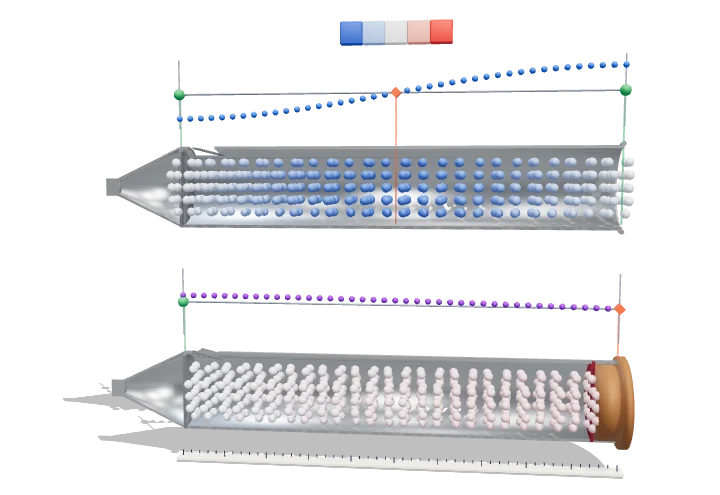
Sound is air being squeezed and stretched as it moves back and forth. Inside a pipe, sound bounces off the ends and builds up into a steady pattern called a standing wave, but only at certain pitches that “fit” the pipe. Closing one end changes which waves fit, so the pipe sounds lower and loses some of its notes.
An air column in a pipe resonates when a whole number of half- or quarter-wavelengths fits between its ends, with displacement antinodes at open ends and displacement nodes at closed ends. An open pipe therefore sounds every harmonic f = nv/2L, while a stopped pipe of the same length sounds only odd harmonics f = nv/4L and is an octave lower.
Key facts
- Model pipe length
- L = 0.50 m, v = 343 m/s (air, 20 °C)
- Open pipe fundamental
- v/2L = 343 Hz (≈ F4)
- Stopped pipe fundamental
- v/4L = 171.5 Hz (≈ F3), one octave lower
- Open pipe harmonics
- n = 1, 2, 3, 4 …
- Stopped pipe harmonics
- n = 1, 3, 5, 7 … (odd only)
- End correction (unflanged open end)
- ΔL ≈ 0.61 r
Parts you can explore (11)
- Open pipe
- Stopped pipe
- Stopper
- Mouths and feet
- Air particles (open pipe)
- Air particles (stopped pipe)
- Displacement graphs
- Displacement nodes
- Displacement antinodes
- Length scale
- Pressure colour key
In the 3D model
Rotate and take apart the model, follow a guided tour of what each part does and why it’s needed, change it with a live slider, and test yourself with a short quiz. Free, no sign-up.
Open Organ pipes and standing waves in 3D →
OpenArc Models’ models are simplified teaching schematics. Terms · Privacy