Electromagnetism & electronics
Optical fibre
Optics · Communications
 Open the interactive 3D model →
How can light travel thousands of kilometres under the ocean inside a glass thread thinner than a hair?
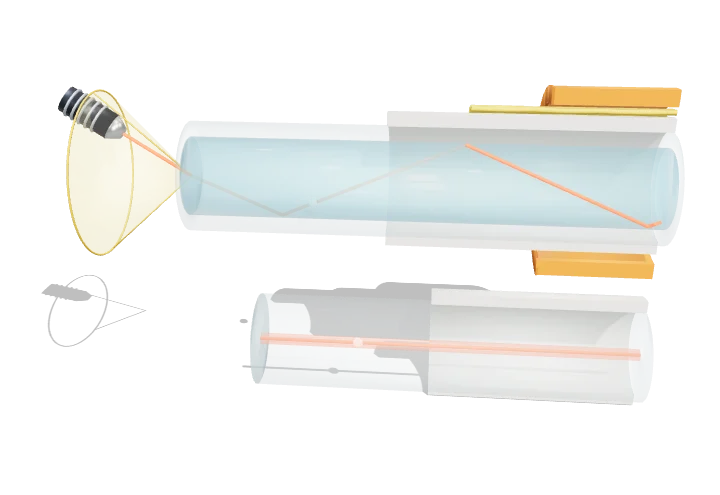
An optical fibre is a glass thread with a central core of glass that bends light slightly more than the glass wrapped around it. Light shone into the core keeps hitting the boundary at a shallow, glancing angle, and every time it bounces straight back in. So the light zig-zags along the fibre, trapped, even round gentle bends.
An optical fibre guides light along a thin glass core surrounded by a cladding of slightly lower refractive index, so that rays meeting the boundary beyond the critical angle are totally internally reflected. The index contrast fixes the numerical aperture — the range of launch angles that will be guided — and the core size decides whether many modes or just one can propagate.
Key facts
- Core / cladding diameter, single-mode
- ≈ 9 / 125 µm
- Core / cladding diameter, multimode
- 50 or 62.5 / 125 µm (graded index); 100 / 140 µm and larger (step index)
- Index difference core – cladding
- ≈ 0.3–1.5 %
- Attenuation, single-mode at 1550 nm
- ≈ 0.15–0.2 dB/km
- Speed of light in the core
- ≈ 2.0 × 10⁸ m/s (≈ 5 µs per km)
- Numerical aperture (this model)
- 0.22 → acceptance half-angle 12.7°
Parts you can explore (10)
- Core
- Cladding
- Buffer coating
- Strength yarn
- Jacket
- Acceptance cone
- Laser source
- Guided ray
- Escaping light
- Single-mode fibre
In the 3D model
Rotate and take apart the model, follow a guided tour of what each part does and why it’s needed, change it with a live slider, and test yourself with a short quiz. Free, no sign-up.
OpenArc Models’ models are simplified teaching schematics. Terms · Privacy