Human body
Olfaction and the nasal cavity
Anatomy · Special senses
 Open the interactive 3D model →
With only about 400 kinds of smell detector, how can you tell apart coffee, roses and a thousand other smells?
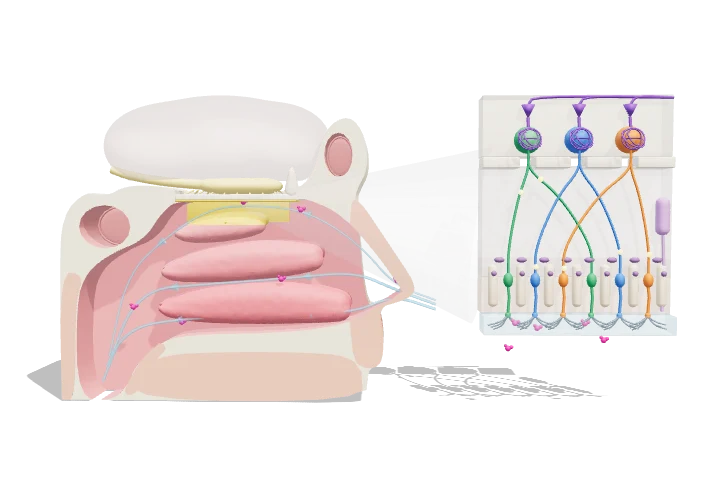
When you breathe in, tiny smell molecules drift up to a small patch of special lining in the roof of your nose. Nerve cells there carry detectors that each catch certain molecules and send signals straight up into the brain. Each smell switches on its own mix of detector types, and the brain reads that mix like a chord on a piano.
The nasal cavity conditions inspired air with its conchae and mucosa, and a small patch of olfactory epithelium in its roof detects odour molecules. Olfactory receptor neurons, each expressing one receptor type, send axons through the cribriform plate to glomeruli in the olfactory bulb, where the pattern of activity across glomeruli encodes the odour.
Key facts
- Olfactory epithelium area
- ≈ 1–5 cm² per side in adults (estimates vary widely)
- Receptor neurons
- ≈ 5–10 million (both sides)
- Functional odorant receptor genes
- ≈ 350–400 in humans (≈ 1000 in mice)
- Glomeruli per bulb
- ≈ 5000 in adult humans (estimates vary)
- Receptor neuron lifespan
- ≈ 30–60 days, replaced from basal cells
- Air reaching the olfactory cleft
- ≈ 10–15% of nasal airflow at rest
Parts you can explore (16)
- External nose
- Nasal cavity & palate
- Inferior concha
- Middle concha
- Superior concha
- Olfactory epithelium
- Cribriform plate
- Olfactory bulb & tract
- Paranasal sinuses
- Frontal lobe (context)
- Airflow & odour molecules
- Olfactory receptor neurons (inset)
- Supporting & basal cells (inset)
- Mucus & cilia (inset)
- Glomeruli & mitral cells (inset)
- Nerve impulses (inset)
In the 3D model
Rotate and take apart the model, follow a guided tour of what each part does and why it’s needed, change it with a live slider, and test yourself with a short quiz. Free, no sign-up.
Open Olfaction and the nasal cavity in 3D →
OpenArc Models’ models are simplified teaching schematics. Terms · Privacy