Electromagnetism & electronics
OLED pixel stack
Electronics · Displays
 Open the interactive 3D model →
Why does a black OLED screen look truly black, even in a dark room?
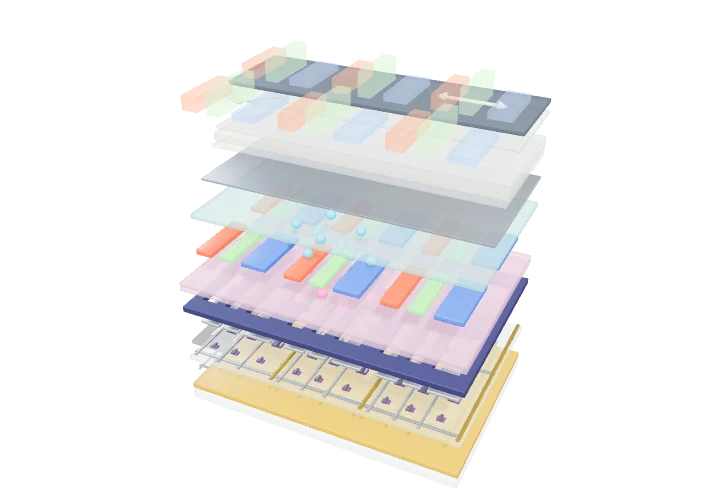
In an OLED screen every tiny coloured dot makes its own light — there is no lamp behind it. Each dot is a sandwich of ultra-thin layers: one side pushes in positive charges, the other side negative ones, and where they meet in the middle they give off a flash of coloured light. A black dot is simply switched off, so it gives no light at all.
An organic light-emitting diode (OLED) is a stack of thin organic semiconductor films between two electrodes: holes and electrons injected from opposite sides meet in an emissive layer, form excitons and release their energy as light. In an active-matrix OLED display every red, green and blue subpixel is its own diode, and a small transistor circuit beneath it sets the current — and so the brightness — for each frame.
Key facts
- Total organic stack thickness
- ≈ 100–300 nm
- Operating voltage per subpixel
- ≈ 3–6 V
- Internal quantum efficiency, phosphorescent emitters
- up to ≈ 100 % (red, green)
- Internal quantum efficiency, fluorescent blue
- ≈ 25 % (≈ 40 % with triplet–triplet annihilation)
- Typical external quantum efficiency
- ≈ 10–30 %
- Subpixel current at full brightness (phone)
- a few nanoamperes
Parts you can explore (12)
- Substrate
- TFT backplane
- Anode
- Pixel-defining layer
- Hole-transport layer
- Emissive layers
- Electron-transport layer
- Cathode
- Encapsulation
- Circular polariser
- Emitted light
- Charge carriers
In the 3D model
Rotate and take apart the model, follow a guided tour of what each part does and why it’s needed, change it with a live slider, and test yourself with a short quiz. Free, no sign-up.
OpenArc Models’ models are simplified teaching schematics. Terms · Privacy