Power & energy
Offshore wind turbine
Renewable energy · Wind power
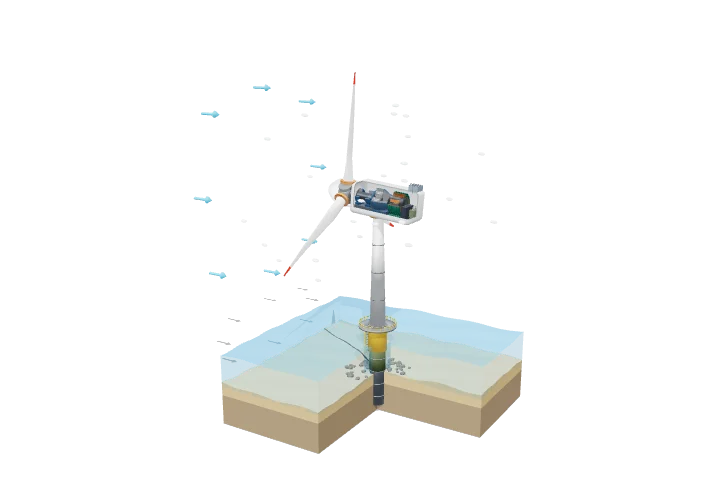 Open the interactive 3D model →
How can three slowly turning blades out at sea power thousands of homes?
An offshore wind turbine is a giant electric generator on a steel post in the sea, with blades longer than a football pitch. The wind pushes on the wing-shaped blades and makes them turn, and the turning shaft spins a generator that makes electricity. A little more wind gives a lot more power: twice the wind speed carries eight times the power.
An offshore wind turbine uses three lifting blades to extract kinetic energy from the wind and turn it into electricity through a shaft, a geared or direct-drive generator and a power converter. Its output follows a power curve set by the cube of wind speed below rated power, by blade pitch control above it, and by cut-in and cut-out limits at the extremes.
Key facts
- Example machine
- 15 MW class: 236 m rotor, 150 m hub height
- Power captured
- P = ½ρAv³Cp (cube of wind speed)
- Betz limit
- Cp ≤ 16/27 ≈ 0.593; modern rotors reach ≈ 0.45–0.50
- Typical power curve
- cut-in ≈ 3 m/s, rated ≈ 10–12 m/s, cut-out ≈ 25 m/s
- Rotor speed
- ≈ 5–7.5 rpm; blade tips up to ≈ 90–95 m/s
- Offshore capacity factor
- ≈ 40–50 % at good North Sea sites
Parts you can explore (16)
- Blades
- Pitch bearings
- Hub and spinner
- Main shaft and bearings
- Gearbox
- Generator
- Converter and transformer
- Nacelle
- Yaw drive
- Tower
- Transition piece
- Monopile foundation
- Seabed and scour protection
- Export cable
- Sea
- Wind
In the 3D model
Rotate and take apart the model, follow a guided tour of what each part does and why it’s needed, change it with a live slider, and test yourself with a short quiz. Free, no sign-up.
Open Offshore wind turbine in 3D →
OpenArc Models’ models are simplified teaching schematics. Terms · Privacy