Plants & animals
Octopus
Molluscs · Cephalopod anatomy
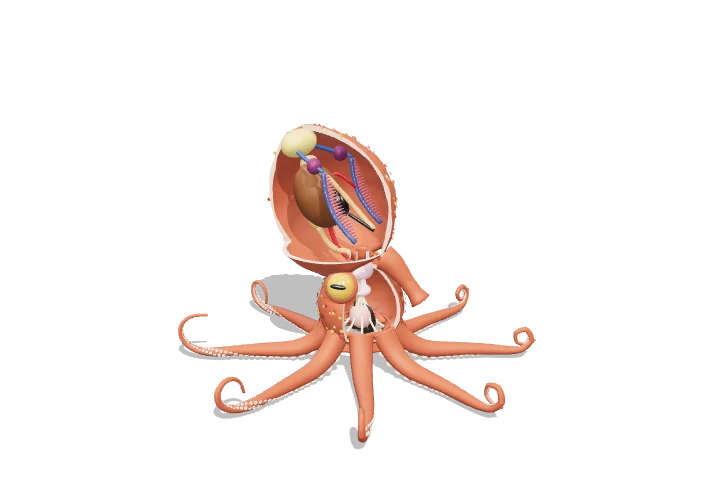 Open the interactive 3D model →
How does an animal with no bones change colour in under a second and squeeze through a coin-sized hole?
An octopus is a soft-bodied relative of snails that has lost its shell. It swims by squirting water out of a tube, breathes with gills, and has three hearts and blue blood. Its skin is covered in tiny colour sacs that its brain can open and close in a blink.
The octopus is a shell-less cephalopod mollusc whose muscular mantle ventilates two gills and powers jet propulsion through the siphon. Three hearts, copper-based blood, a ring-shaped brain around the oesophagus and skin packed with neurally controlled chromatophores make it one of the most specialised invertebrates.
Key facts
- Species modelled
- Common octopus, Octopus vulgaris
- Size
- Mantle up to ≈ 25 cm; arm span typically 1–1.3 m; mass usually 3–10 kg
- Hearts
- 3 (two branchial, one systemic)
- Respiratory pigment
- Haemocyanin (copper), blue when oxygenated
- Neurons
- ≈ 500 million, about two-thirds of them in the arms
- Lifespan
- ≈ 1–2 years; females die after brooding their eggs
Parts you can explore (13)
- Mantle
- Head
- Eyes
- Arms and suckers
- Siphon
- Chromatophores
- Gills
- Branchial hearts
- Systemic heart
- Ink sac
- Digestive organs
- Beak and radula
- Brain
In the 3D model
Rotate and take apart the model, follow a guided tour of what each part does and why it’s needed, change it with a live slider, and test yourself with a short quiz. Free, no sign-up.
OpenArc Models’ models are simplified teaching schematics. Terms · Privacy