Earth & space
Ocean circulation
Earth science · Oceanography
 Open the interactive 3D model →
Why is Britain so much milder than Canada at the same latitude — and could melting ice change that?
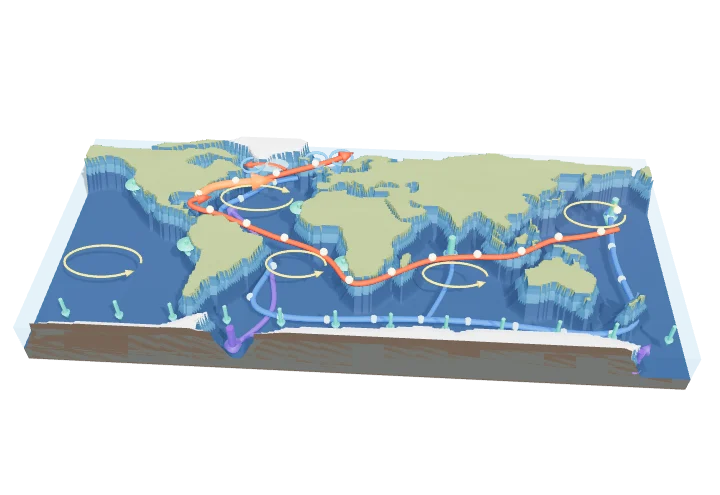
The oceans are always moving. Winds push fast currents around the surface, carrying warm water from the tropics towards the poles. In the far North Atlantic and around Antarctica, water gets so cold and salty that it becomes heavy, sinks to the sea floor and creeps around the world for about a thousand years before rising again.
The ocean circulates in two coupled ways: winds drive fast surface currents and gyres, while differences in temperature and salinity drive a slow, deep overturning known as the thermohaline circulation or global conveyor. Together they move heat from the tropics toward the poles, ventilate the deep ocean and store carbon for centuries.
Key facts
- AMOC strength at 26.5° N
- ≈ 17 Sv (RAPID array, 2004 onward)
- 1 sverdrup (Sv)
- 10⁶ m³/s, close to the discharge of all the world’s rivers combined (≈ 1.2 Sv)
- Northward ocean heat transport, Atlantic 26.5° N
- ≈ 1.2 PW
- Time for one conveyor circuit
- ≈ 1000 years (deep-water ages up to ~1500 years in the North Pacific)
- Seawater density at the surface
- ≈ 1020–1029 kg/m³
- Mean ocean depth
- ≈ 3.7 km
Parts you can explore (12)
- Continents
- Ocean floor
- Ocean water
- Warm surface currents
- Gulf Stream
- Cold deep currents
- North Atlantic Deep Water formation
- Antarctic Bottom Water
- Upwelling zones
- Subtropical gyres
- Freshwater input
- Flow particles
In the 3D model
Rotate and take apart the model, follow a guided tour of what each part does and why it’s needed, change it with a live slider, and test yourself with a short quiz. Free, no sign-up.
Open Ocean circulation in 3D →
OpenArc Models’ models are simplified teaching schematics. Terms · Privacy