Power & energy
PWR fuel assembly
Nuclear power · Reactor fuel
 Open the interactive 3D model →
What does the fuel of a nuclear power station actually look like?
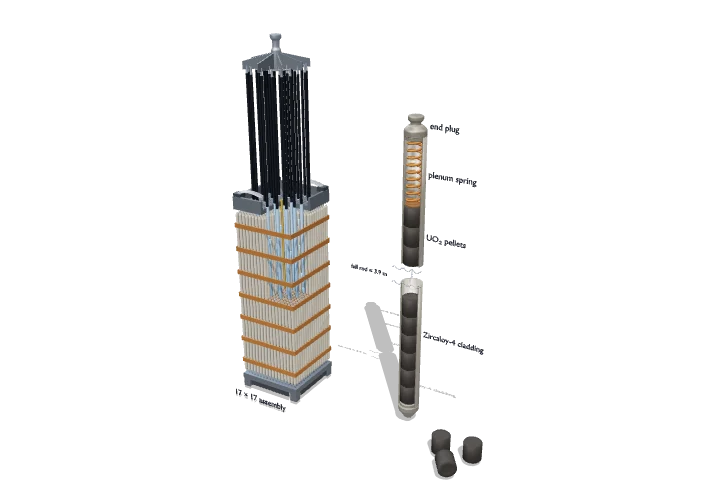
Nuclear fuel is not a glowing liquid: it is thousands of small ceramic pellets, each about the size of a fingertip, stacked inside long thin metal tubes. Two hundred and sixty-four of these rods are bundled into a square, and water rushes up between them to carry the heat away. Control rods slide down into empty tubes in the bundle to turn the power down.
A pressurised-water-reactor (PWR) core is built from about 150–240 square fuel assemblies, each a 17 × 17 lattice of Zircaloy-clad rods filled with enriched UO₂ pellets and held by spacer grids between two steel nozzles. Twenty-four guide tubes in each assembly accept the absorber rodlets of a control-rod cluster, which regulates the local neutron population and therefore the heat produced.
Key facts
- Lattice
- 17 × 17: 264 fuel rods, 24 guide tubes, 1 instrument tube
- Assembly size
- ≈ 214 mm square × ≈ 4.06 m tall; ≈ 420–530 kg of uranium, depending on design
- Fuel rod
- 9.5 mm outer diameter, 0.57 mm Zircaloy wall, ≈ 3.66 m active length
- Pellet
- UO₂, ≈ 8.2 mm × ≈ 9.8 mm, ≈ 95–96 % of theoretical density
- Enrichment
- ≈ 3–5 % U-235 (licensed limit 5 % in most countries)
- Average heat per rod
- ≈ 67 kW (≈ 18 kW/m) in a 3411 MWt, 193-assembly core
Parts you can explore (13)
- UO₂ fuel pellets
- Zircaloy cladding
- Plenum spring
- End plugs
- Fuel rods
- Guide tubes
- Instrument tube
- Spacer grids
- Top nozzle
- Bottom nozzle
- Control-rod cluster
- Spider
- Coolant flow
In the 3D model
Rotate and take apart the model, follow a guided tour of what each part does and why it’s needed, change it with a live slider, and test yourself with a short quiz. Free, no sign-up.
Open PWR fuel assembly in 3D →
OpenArc Models’ models are simplified teaching schematics. Terms · Privacy