Power & energy
Nuclear fission chain reaction
Nuclear physics · Fission
 Open the interactive 3D model →
How can splitting one atom’s nucleus release millions of times more energy than burning a molecule of fuel?
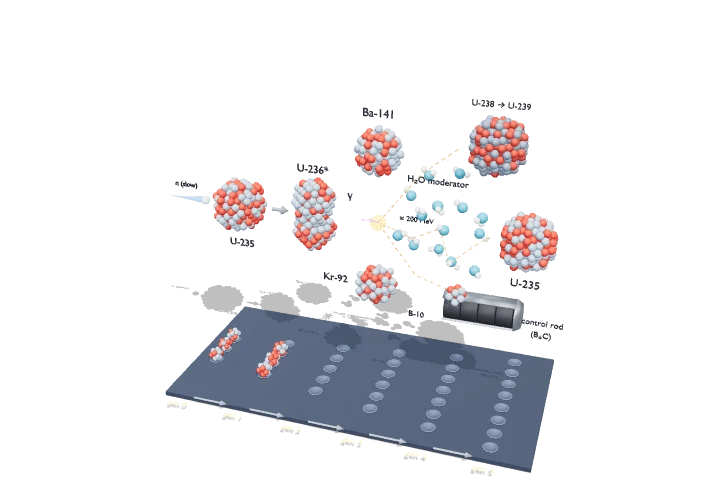
At the centre of every atom is a tiny nucleus made of protons and neutrons. When a slow neutron hits a uranium-235 nucleus, the nucleus wobbles, splits in two and flings out a burst of energy plus two or three new neutrons. If those neutrons go on to split more uranium, you get a chain reaction — the heat source of a nuclear power station.
When a U-235 nucleus absorbs a slow neutron it becomes an excited U-236 nucleus that splits into two medium-mass fragments, two or three fast neutrons and about 200 MeV of energy. If, on average, exactly one of those neutrons goes on to cause another fission (k = 1), the chain reaction is self-sustaining at constant power.
Key facts
- Energy per fission
- ≈ 200 MeV (3.2 × 10⁻¹¹ J); ≈ 8 × 10¹³ J per kg of U-235
- Neutrons per thermal U-235 fission
- ν ≈ 2.43 (of which ≈ 0.65 % are delayed)
- Thermal fission cross-section, U-235
- ≈ 585 barn at 0.025 eV
- Prompt neutron energy
- mean ≈ 2 MeV
- Delayed-neutron fraction β (U-235)
- ≈ 0.0065
- Natural uranium
- 99.27 % U-238, 0.72 % U-235
Parts you can explore (12)
- Slow neutron
- Uranium-235 nucleus
- Compound nucleus (U-236*)
- Barium-141 fragment
- Krypton-92 fragment
- Energy release
- Fast neutrons
- Moderator (water)
- Next U-235 nucleus
- Uranium-238 capture
- Control rod (boron)
- Chain reaction
In the 3D model
Rotate and take apart the model, follow a guided tour of what each part does and why it’s needed, change it with a live slider, and test yourself with a short quiz. Free, no sign-up.
Open Nuclear fission chain reaction in 3D →
OpenArc Models’ models are simplified teaching schematics. Terms · Privacy