Physics
Newton’s cradle
Mechanics · Momentum and energy
 Open the interactive 3D model →
Lift two balls on a Newton’s cradle and two fly out the other side — why never one ball going twice as fast?
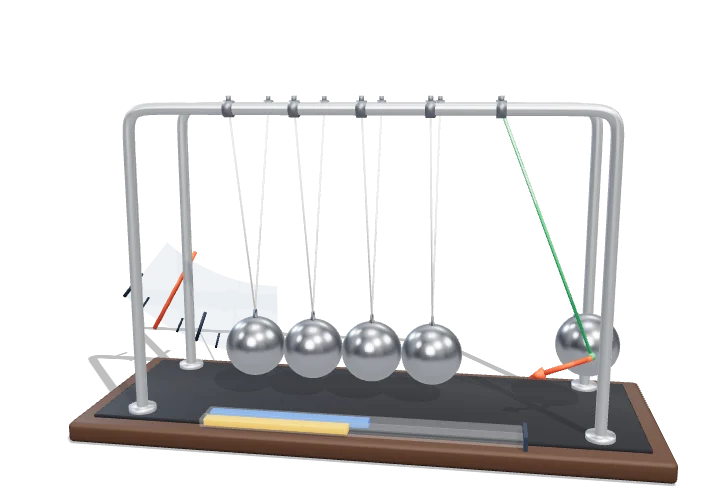
A Newton’s cradle is a row of touching steel balls hanging on strings. When one ball swings in and hits the row, the ball at the far end flies out while the middle ones barely move. The push travels through the row, and two rules of physics together decide exactly how many balls leave and how fast.
A Newton’s cradle is a row of identical, touching pendulums whose nearly elastic collisions pass momentum and kinetic energy along the row, so that n balls released at one end send n balls out of the other at the same speed. It is a compact demonstration that both conservation laws together, not momentum alone, decide the outcome of a collision.
Key facts
- Model balls
- 5 × 25 mm hardened steel, m ≈ 64 g each
- Pendulum length
- L = 10 cm (pivot axis to ball centre)
- Release angle
- 30° → impact speed ≈ 0.51 m/s
- Period at 30°
- ≈ 0.645 s (small-angle 0.634 s)
- Energy per ball released
- ≈ 8.4 mJ
- Impact duration (steel–steel)
- of order 0.1 ms
Parts you can explore (9)
- Base
- Frame
- String clamps
- Steel balls
- Bifilar strings
- Pendulum length
- Angle scale
- Momentum vectors
- Energy bars
In the 3D model
Rotate and take apart the model, follow a guided tour of what each part does and why it’s needed, change it with a live slider, and test yourself with a short quiz. Free, no sign-up.
OpenArc Models’ models are simplified teaching schematics. Terms · Privacy