Astronomy & space
Neutron star and pulsar
Astrophysics · Compact objects
 Open the interactive 3D model →
What could flash with a beat steadier than most clocks, from thousands of light-years away?
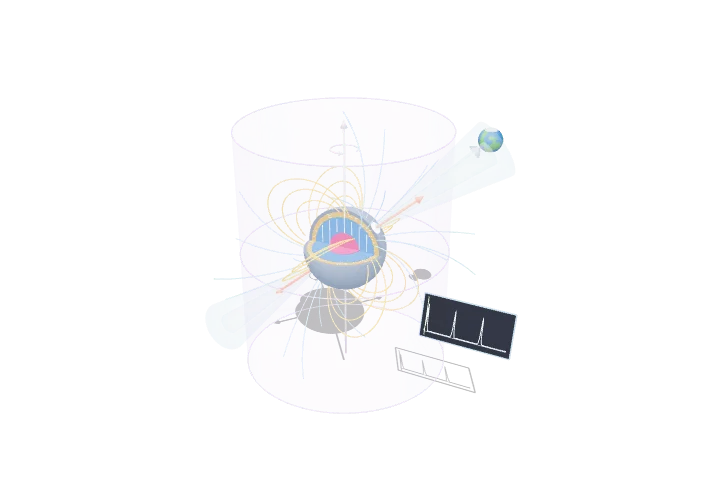
When a giant star explodes, its core can be crushed into a ball only about 24 km across but heavier than the Sun — a neutron star. It spins very fast and acts like a powerful magnet, shooting beams of radio waves from its magnetic poles. If a beam sweeps past Earth, we pick up a regular “tick” every turn and call it a pulsar.
A neutron star is the collapsed core of a massive star: about 1.4 solar masses packed into a sphere roughly 24 km across, spinning rapidly and threaded by an intense magnetic field. When its magnetic axis is tilted from its spin axis, beams of radiation from the magnetic poles sweep around like a lighthouse, and we detect a pulsar if a beam crosses Earth.
Key facts
- Typical mass
- ≈ 1.4 M☉ (observed ~1.1–2.1 M☉)
- Radius
- ≈ 11–13 km
- Mean density
- ≈ 4–7 × 10¹⁷ kg/m³
- Spin periods
- ≈ 1.4 ms to tens of seconds
- Surface magnetic field
- ≈ 10⁴–10⁵ T (millisecond pulsars), ≈ 10⁸ T (ordinary), up to ~10¹¹ T (magnetars)
- Known pulsars
- > 3,000 (ATNF catalogue)
Parts you can explore (12)
- Outer crust
- Inner crust
- Superfluid outer core
- Inner core
- Spin axis
- Magnetic axis
- Polar caps
- Magnetic field lines
- Radio beams
- Light cylinder
- Earth observer
- Pulse profile
In the 3D model
Rotate and take apart the model, follow a guided tour of what each part does and why it’s needed, change it with a live slider, and test yourself with a short quiz. Free, no sign-up.
Open Neutron star and pulsar in 3D →
OpenArc Models’ models are simplified teaching schematics. Terms · Privacy