Human body
Neuron and synapse
Neuroscience · Nerve cells
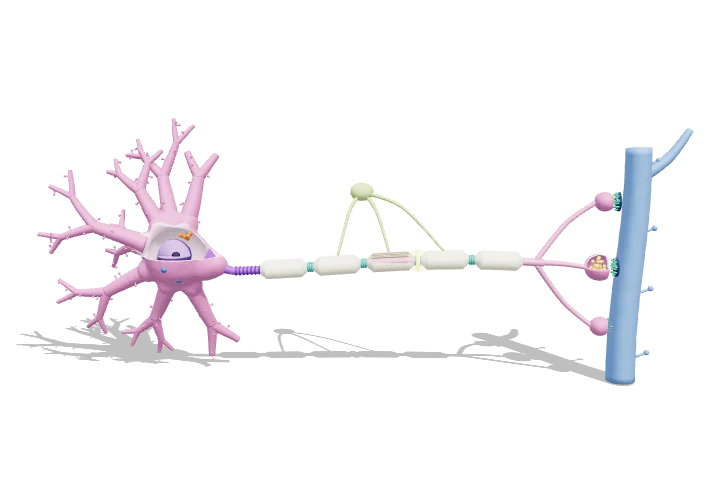 Open the interactive 3D model →
How does a thought travel from your brain to your toes in a fiftieth of a second?
Nerve cells, called neurons, pass messages as tiny electrical pulses. A pulse races along a long thin fibre, then jumps across a narrow gap to the next cell as a puff of chemicals. Your brain has about 86 billion neurons doing this all the time.
A neuron sums synaptic inputs on its dendrites and soma and, when the axon initial segment reaches threshold, fires an all-or-none action potential produced by voltage-gated Na⁺ and K⁺ channels. The impulse leaps between nodes of Ranvier along the myelinated axon, and at the terminals Ca²⁺ entry triggers vesicle fusion and neurotransmitter release onto receptors of the next cell.
Key facts
- Resting membrane potential
- ≈ −60 to −70 mV
- Threshold / peak
- ≈ −55 mV / ≈ +30 to +40 mV
- Action-potential duration
- ≈ 1–2 ms
- Conduction velocity
- ≈ 0.5–2 m/s (unmyelinated) to ≈ 120 m/s (large myelinated)
- Synaptic cleft width
- ≈ 20–40 nm
- Neurons in the human brain
- ≈ 86 × 10⁹
Parts you can explore (13)
- Soma
- Dendrites
- Axon hillock
- Axon
- Myelin sheath
- Nodes of Ranvier
- Axon terminals
- Synaptic vesicles
- Synaptic target
- Postsynaptic receptors
- Cell nucleus
- Neuron mitochondria
- Signal pulse
In the 3D model
Rotate and take apart the model, follow a guided tour of what each part does and why it’s needed, change it with a live slider, and test yourself with a short quiz. Free, no sign-up.
Open Neuron and synapse in 3D →
OpenArc Models’ models are simplified teaching schematics. Terms · Privacy