Human body
Nephron
Anatomy · Urinary system
 Open the interactive 3D model →
Your kidneys filter about 180 litres of fluid a day — so why do you only pee about 1.5 litres?
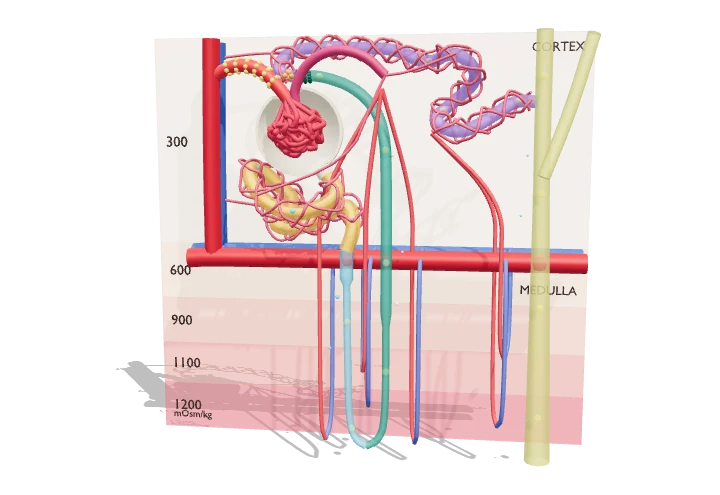
Each kidney contains about a million tiny tubes called nephrons. At one end a ball of capillaries squeezes fluid out of the blood; the rest of the tube then takes back almost everything useful, including about 99% of the water. A hormone called ADH decides how much more water to save, so your urine can be watery or concentrated.
The nephron filters plasma at the glomerulus and then reclaims almost all of that filtrate as it flows through a series of specialised tubule segments. By building an osmotic gradient in the medulla and letting ADH control the water permeability of the collecting duct, the kidney can excrete urine anywhere from about 50 to 1200 mOsm/kg.
Key facts
- Nephrons per kidney
- ≈ 1 million (range ~0.2–2.7 million)
- Glomerular filtration rate
- ≈ 125 mL/min ≈ 180 L/day (both kidneys)
- Fraction of filtrate reabsorbed
- ≈ 99% (urine ≈ 1–2 L/day)
- Urine osmolality range
- ≈ 50–1200 mOsm/kg H₂O
- Juxtamedullary nephrons
- ≈ 15% of nephrons; long loops into the inner medulla
- Nephron length
- ≈ 30–55 mm (excluding collecting duct)
Parts you can explore (15)
- Bowman's capsule
- Glomerulus
- Afferent arteriole
- Efferent arteriole
- Proximal convoluted tubule
- Descending limb of Henle
- Ascending limb of Henle
- Distal convoluted tubule
- Collecting duct
- Peritubular capillaries
- Vasa recta
- Juxtaglomerular apparatus
- Interlobular artery & vein
- Medullary osmotic gradient
- Filtrate & reabsorption
In the 3D model
Rotate and take apart the model, follow a guided tour of what each part does and why it’s needed, change it with a live slider, and test yourself with a short quiz. Free, no sign-up.
OpenArc Models’ models are simplified teaching schematics. Terms · Privacy