Chemistry
Rock-salt crystal (NaCl)
Solid-state chemistry · Ionic lattice
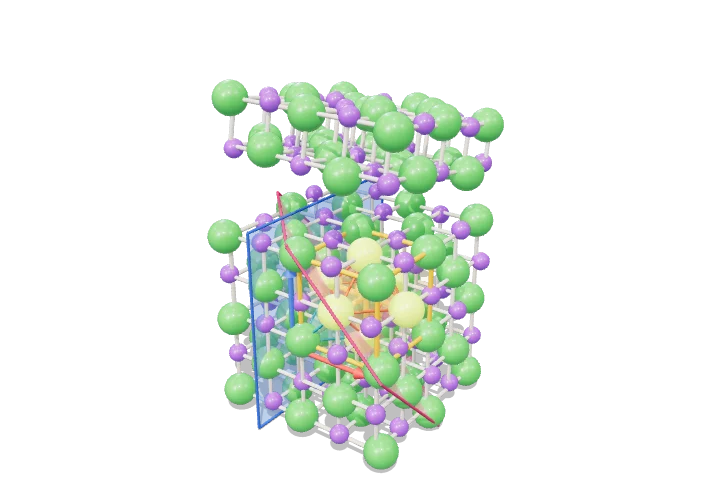 Open the interactive 3D model →
Why do grains of table salt come out as tiny cubes when you look at them under a magnifying glass?
Salt is made of two kinds of charged particles — sodium ions and chloride ions — stacked in a perfectly regular pattern. Every sodium ion is surrounded by six chloride ions and every chloride by six sodium ions, building up cube after cube. The crystal splits most easily along flat layers, so it breaks into cubes.
Sodium chloride crystallises in the rock-salt structure: two interpenetrating face-centred cubic lattices of Na⁺ and Cl⁻, each ion octahedrally surrounded by six of the other. Its geometry follows from ion sizes and electrostatics, and its stability is measured by a lattice energy of about 787 kJ mol⁻¹.
Key facts
- Structure type
- Rock salt (halite), space group Fm3̄m, Z = 4
- Cell edge a
- 5.640 Å at room temperature
- Na⁺–Cl⁻ distance
- a/2 = 2.820 Å
- Ionic radii (CN 6)
- Na⁺ 1.02 Å, Cl⁻ 1.81 Å (Shannon)
- Coordination
- 6 : 6 octahedral
- Lattice enthalpy
- ≈ 787 kJ mol⁻¹ (Born–Haber)
Parts you can explore (10)
- Na⁺ ions
- Cl⁻ ions
- Ionic contacts
- Unit cell
- Lattice vectors
- Octahedral site
- Tetrahedral hole
- (100) plane
- (111) plane
- Cleaved (100) slab
In the 3D model
Rotate and take apart the model, follow a guided tour of what each part does and why it’s needed, change it with a live slider, and test yourself with a short quiz. Free, no sign-up.
Open Rock-salt crystal (NaCl) in 3D →
OpenArc Models’ models are simplified teaching schematics. Terms · Privacy