Plants & animals
Mushroom
Fungi · Basidiomycete
 Open the interactive 3D model →
If a mushroom is only the fruit, where is the rest of the fungus hiding?
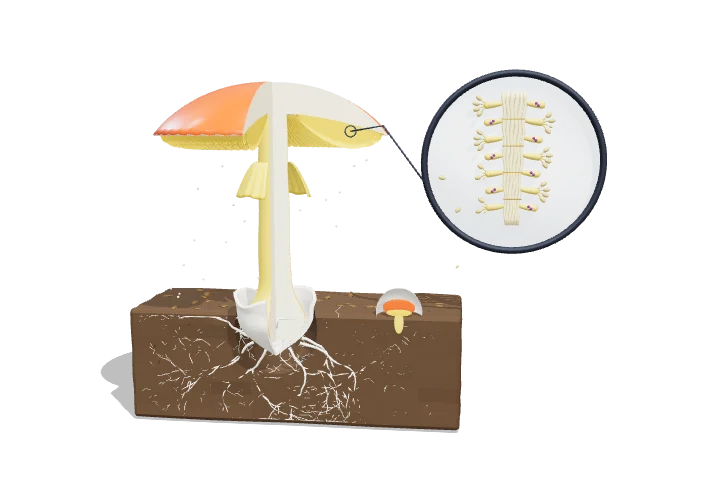
A mushroom is just the part of a fungus that pops up to spread spores, like an apple on a tree. The real fungus is a huge web of threads, called mycelium, hidden in the soil, which can live for years. Under the cap, thin gills shoot out billions of tiny spores that drift away on the air.
A mushroom is the spore-producing fruiting body of a fungus whose main body, the mycelium, lives hidden in soil or wood as a network of microscopic hyphae. On the gills, basidia produce haploid basidiospores by meiosis and launch them with a surface-tension catapult so they can fall free and be carried away by air currents.
Key facts
- Model based on
- Amanita (Caesar’s mushroom type), phylum Basidiomycota
- Hyphal diameter
- ≈ 2–10 µm
- Spores per basidium
- 4 (typical)
- Basidiospore size (Amanita)
- ≈ 8–12 µm long
- Discharge distance
- ≈ 0.1 mm from the gill face
- Largest known fungal individual
- Armillaria ostoyae, Oregon: ≈ 9.6 km²
Parts you can explore (10)
- Pileus (cap)
- Gills (lamellae)
- Stipe
- Annulus (ring)
- Volva
- Mycelium
- Button (primordium)
- Basidia (inset)
- Basidiospores
- Soil
In the 3D model
Rotate and take apart the model, follow a guided tour of what each part does and why it’s needed, change it with a live slider, and test yourself with a short quiz. Free, no sign-up.
OpenArc Models’ models are simplified teaching schematics. Terms · Privacy