Electromagnetism & electronics
Brushed DC motor
Electromagnetism · Motors
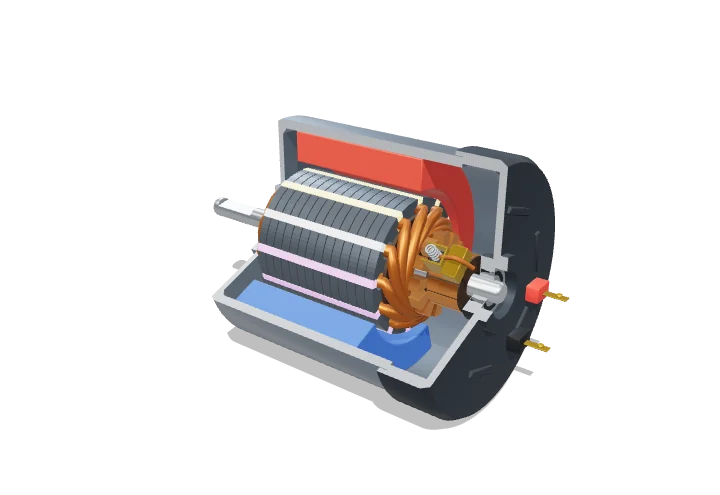 Open the interactive 3D model →
How does a battery make a toy car’s wheels spin when nothing inside the motor touches the magnets?
Inside a DC motor, copper coils sit between two magnets. When electric current flows through the coils, the magnets push on them and the middle part spins. A clever switch on the shaft keeps flipping the current so the push always goes the same way round.
A brushed DC motor produces torque from the force on current-carrying armature conductors lying in the field of stationary permanent magnets, while a mechanical commutator reverses each coil’s current as it passes the neutral axis so the torque always acts the same way. As the armature speeds up it generates a back-EMF proportional to speed, which limits the current and gives the motor its straight-line speed–torque characteristic.
Key facts
- Torque law
- T = k_t I
- Back-EMF law
- E = k_e ω (k_e = k_t in SI units)
- Speed–torque curve
- Straight line from no-load speed to stall torque
- Maximum mechanical power
- At half stall torque and half no-load speed
- Efficiency
- ≈ 50–75% (small motors); ≈ 85–90% (large industrial)
- Brush contact drop
- ≈ 1–2 V in total (carbon/graphite brushes)
Parts you can explore (11)
- Housing
- Stator magnets
- Rotor & windings
- Conductor currents
- Commutator
- Brushes
- Brush holders & springs
- Shaft
- Bearings
- End bell
- Terminal block
In the 3D model
Rotate and take apart the model, follow a guided tour of what each part does and why it’s needed, change it with a live slider, and test yourself with a short quiz. Free, no sign-up.
OpenArc Models’ models are simplified teaching schematics. Terms · Privacy