Plants & animals
Moss life cycle
Plants · Bryophytes
 Open the interactive 3D model →
Those tiny stalks poking up from a moss cushion — are they flowers, and what do they do?
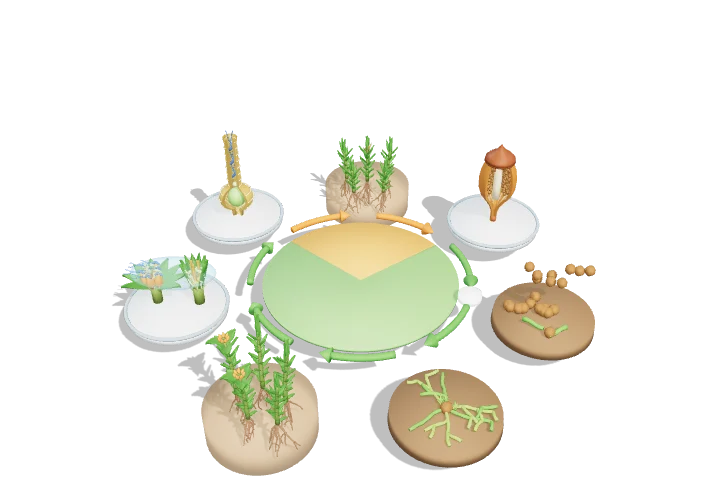
The soft green moss you can touch is only half of the plant’s life. When it rains, the moss makes swimming sperm that reach an egg, and the fertilised egg grows into a thin stalk with a capsule on top. That capsule is not a flower: it is a spore pot that sprinkles dust-like spores into the wind to start new moss.
Mosses alternate between a long-lived, photosynthetic haploid gametophyte — the leafy green plant — and a short-lived diploid sporophyte that grows on it as a stalk and capsule. Sperm must swim through water to fertilise the egg, and meiosis in the capsule produces haploid spores that are released by the operculum and peristome and dispersed by wind.
Key facts
- Dominant generation
- Haploid gametophyte (n)
- Sporophyte
- Diploid (2n), unbranched; foot, seta and capsule
- Gamete production
- By mitosis in antheridia and archegonia
- Spore production
- By meiosis in the capsule (sporic meiosis)
- Spore size
- ≈ 10–25 µm in most mosses
- Species
- ≈ 12,000 mosses (Bryophyta)
Parts you can explore (14)
- Life-cycle ring
- Spores
- Protonema
- Gametophyte shoots
- Rhizoids
- Antheridia
- Archegonia
- Sperm
- Egg and zygote
- Seta
- Capsule
- Calyptra
- Operculum
- Peristome teeth
In the 3D model
Rotate and take apart the model, follow a guided tour of what each part does and why it’s needed, change it with a live slider, and test yourself with a short quiz. Free, no sign-up.
OpenArc Models’ models are simplified teaching schematics. Terms · Privacy