Electromagnetism & electronics
MOSFET
Electronics · Semiconductor devices
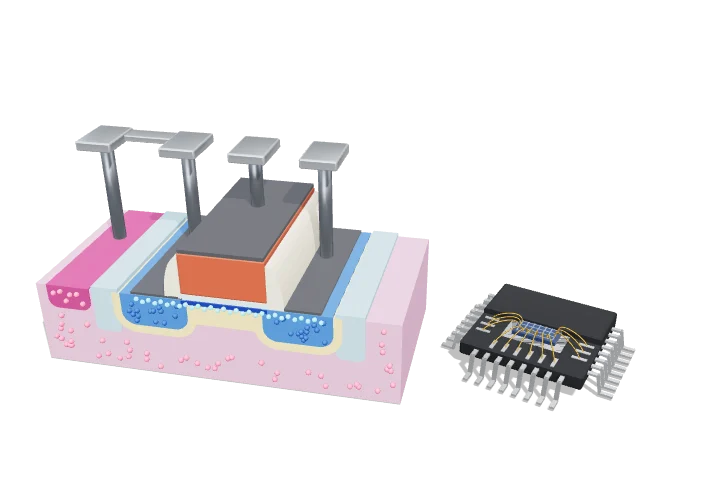 Open the interactive 3D model →
How can a switch with no moving parts flip billions of times a second inside your phone?
A MOSFET is a tiny electronic switch made of silicon, and a phone chip holds billions of them. A metal plate called the gate sits just above the silicon but never touches it. Put a positive voltage on the gate and it pulls electrons into a thin bridge between two terminals, so current can flow — switch the voltage off and the bridge disappears.
A metal–oxide–semiconductor field-effect transistor (MOSFET) controls the current between source and drain with the electric field of an insulated gate. Above a threshold voltage the gate inverts the silicon surface into a thin conducting channel, so a voltage, not a current, switches the device.
Key facts
- Terminals
- Source, drain, gate, body (substrate)
- Threshold voltage
- ≈ 0.2–0.5 V in logic; ≈ 2–4 V in power MOSFETs
- Gate oxide
- ≈ 1–2 nm equivalent SiO₂ thickness in modern logic
- Channel thickness
- ≈ 1–5 nm (inversion layer)
- Gate current (static)
- Essentially zero apart from tunnelling leakage
- Transistors on large chips
- > 10¹¹ in the biggest 2020s processors
Parts you can explore (12)
- p-type substrate
- Source (n+)
- Drain (n+)
- Gate oxide
- Polysilicon gate
- Metal contacts
- Body contact
- Inversion channel
- Depletion region
- Channel electrons
- Shallow trench isolation
- IC package
In the 3D model
Rotate and take apart the model, follow a guided tour of what each part does and why it’s needed, change it with a live slider, and test yourself with a short quiz. Free, no sign-up.
OpenArc Models’ models are simplified teaching schematics. Terms · Privacy