Astronomy & space
Geology of the Moon
Planetary science · Lunar geology
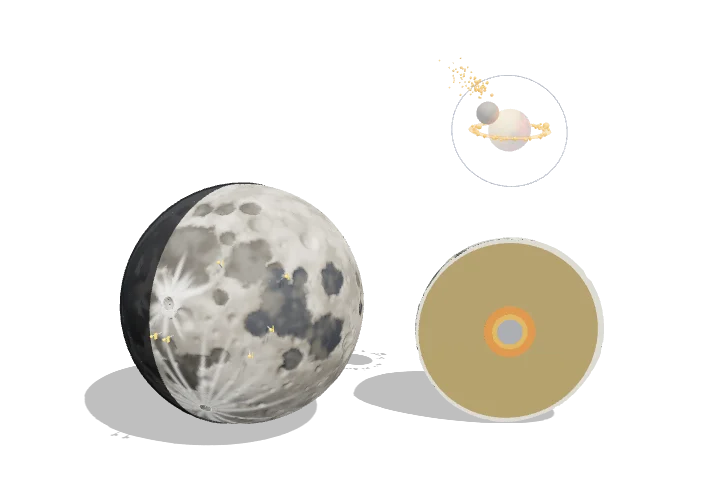 Open the interactive 3D model →
Why does the Moon have a face — and what made its dark patches?
The Moon’s bright areas are ancient mountains of pale rock, covered in craters from billions of years of space rocks hitting it. The dark patches are huge lakes of lava that flooded giant craters and then froze. Because the Moon has no air or rain to wear things away, its surface is a 4-billion-year-old record of what happened in the early Solar System.
The Moon’s bright highlands are an ancient crust of anorthosite that floated on a magma ocean, while its dark maria are younger basalt lavas that filled giant impact basins. Apollo samples and seismometers, together with orbital gravity data, show a thin crust, a thick mantle and a small iron core, consistent with formation from debris of a giant impact on the early Earth.
Key facts
- Radius
- 1,737.4 km (0.27 Earth)
- Mean density
- 3.34 g/cm³ (Earth 5.51)
- Surface gravity
- 1.62 m s⁻² (0.17 g)
- Mean distance
- 384,400 km; receding ≈ 3.8 cm/yr
- Age of highland crust
- ≈ 4.4–4.5 billion years
- Mare basalt ages
- mostly ≈ 3.1–3.9 billion years
Parts you can explore (12)
- Lunar highlands
- Maria
- Far side
- Tycho
- Copernicus
- Apollo landing sites
- Crust
- Mantle
- Partial-melt zone
- Core
- Night-side shadow
- Giant-impact origin
In the 3D model
Rotate and take apart the model, follow a guided tour of what each part does and why it’s needed, change it with a live slider, and test yourself with a short quiz. Free, no sign-up.
Open Geology of the Moon in 3D →
OpenArc Models’ models are simplified teaching schematics. Terms · Privacy