Chemistry
Molecular orbitals of H₂
Physical chemistry · Chemical bonding
 Open the interactive 3D model →
What actually happens to two hydrogen atoms’ electrons when they snap together into a molecule?
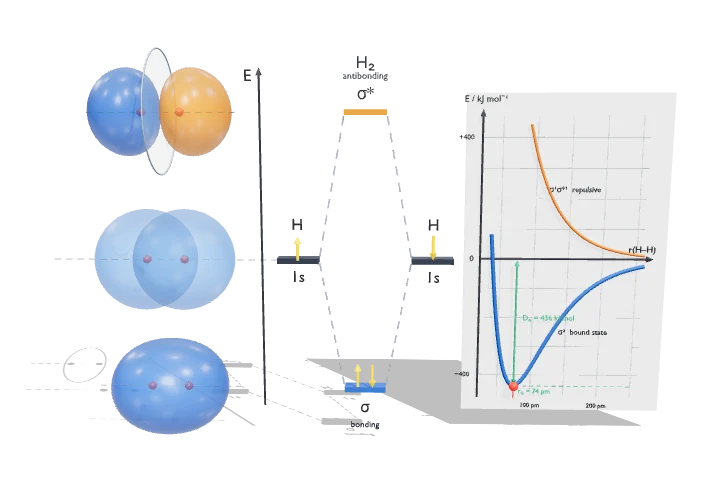
Each hydrogen atom has one electron in a round cloud called an orbital. When two atoms come close, their clouds merge into new shapes that belong to the whole molecule. In one shape the electrons gather between the two nuclei and pull them together — that shared pair is the chemical bond.
When two hydrogen atoms approach, their 1s orbitals combine into a lower-energy σ bonding orbital and a higher-energy σ* antibonding orbital. Two electrons paired in σ give H₂ a single bond, 74 pm long and about 436 kJ/mol deep.
Key facts
- Bond length r₀
- 74.1 pm
- Bond dissociation enthalpy (298 K)
- 436 kJ/mol
- Spectroscopic well depth Dₑ
- ≈ 458 kJ/mol (4.75 eV)
- Bond order
- 1 (σ²)
- Vibrational wavenumber
- ≈ 4161 cm⁻¹ (fundamental)
- First ionisation energy of H₂
- 15.4 eV (vs 13.6 eV for H)
Parts you can explore (10)
- σ bonding orbital
- σ* antibonding orbital
- Nodal plane
- Hydrogen nuclei
- 1s atomic orbitals
- MO energy diagram
- Electron pair
- Potential-energy curve
- Bond energy and length
- Distance marker
In the 3D model
Rotate and take apart the model, follow a guided tour of what each part does and why it’s needed, change it with a live slider, and test yourself with a short quiz. Free, no sign-up.
Open Molecular orbitals of H₂ in 3D →
OpenArc Models’ models are simplified teaching schematics. Terms · Privacy