Cells & molecules
Mitosis
Cell biology · Cell division
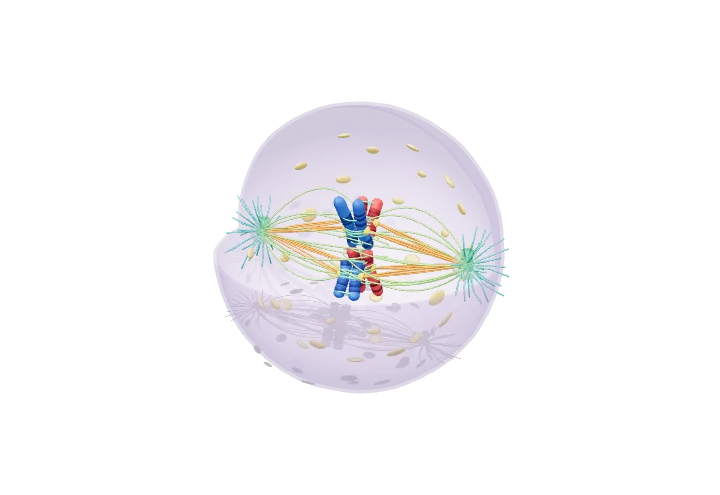 Open the interactive 3D model →
You started as one cell — how did it copy itself into trillions without losing a single gene?
Before a cell divides, it copies every chromosome, so each one becomes a pair of identical twins. In mitosis, a scaffold of protein fibres lines the pairs up in the middle and pulls the twins apart, one to each end. The cell then pinches in two, giving two cells with exactly the same genes.
Mitosis separates the duplicated chromosomes of a eukaryotic cell into two genetically identical nuclei, and cytokinesis then divides the cytoplasm. A microtubule spindle captures each pair of sister chromatids, aligns it at the metaphase plate and, once every kinetochore is correctly attached, pulls the sisters to opposite poles.
Key facts
- Duration (cultured mammalian cell)
- ≈ 30–60 min of a ~24 h cycle
- Human chromosome number
- 2n = 46 → 92 chromatids at metaphase
- DNA content
- 4C before anaphase → 2C in each daughter
- Microtubules per human kinetochore
- ≈ 15–25
- Anaphase chromosome speed
- ≈ 0.5–2 µm/min
- Microtubule diameter
- 25 nm, 13 protofilaments
Parts you can explore (11)
- Plasma membrane
- Nuclear envelope
- Nucleolus
- Sister chromatids
- Kinetochores
- Cohesin
- Centrosomes
- Kinetochore microtubules
- Polar microtubules
- Astral microtubules
- Contractile ring
In the 3D model
Rotate and take apart the model, follow a guided tour of what each part does and why it’s needed, change it with a live slider, and test yourself with a short quiz. Free, no sign-up.
OpenArc Models’ models are simplified teaching schematics. Terms · Privacy