Cells & molecules
Mitochondrion
Cell biology · Organelle
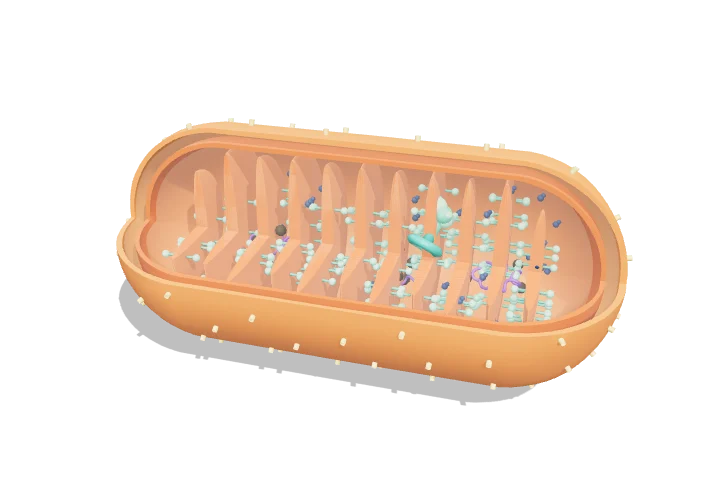 Open the interactive 3D model →
Where does the energy from your breakfast actually go?
Almost every cell in your body contains hundreds of mitochondria, tiny power stations that turn food into a usable energy currency called ATP. They do it by pumping tiny charged particles (protons) across a folded inner wall, then letting them flow back through a spinning molecular turbine.
Mitochondria convert the chemical energy of food into ATP by oxidative phosphorylation. Electron transport builds a proton gradient across the inner membrane, and ATP synthase spends that gradient to make ATP.
Key facts
- Typical size
- 0.5–1 µm wide, 1–10 µm long
- Copies per cell
- ~hundreds to thousands (liver cell ≈ 1,000–2,000)
- Human mtDNA
- 16,569 bp; 37 genes
- Inner-membrane potential
- ≈ 150–180 mV, matrix negative
- ATP per glucose
- ≈ 30–32 (modern estimate)
- ATP per rotor turn
- 3
Parts you can explore (10)
- Outer membrane
- Intermembrane space
- Inner membrane
- Cristae
- Matrix
- ATP synthase
- mtDNA
- Mitoribosomes
- Matrix granules
- Porins
In the 3D model
Rotate and take apart the model, follow a guided tour of what each part does and why it’s needed, change it with a live slider, and test yourself with a short quiz. Free, no sign-up.
OpenArc Models’ models are simplified teaching schematics. Terms · Privacy