Earth & space
Mineral crystals
Earth science · Mineralogy
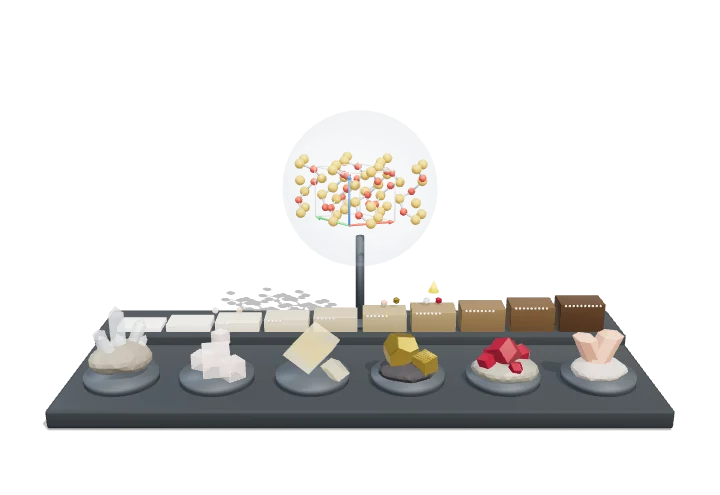 Open the interactive 3D model →
Why does salt grow in perfect little cubes, while quartz grows as six-sided pencils?
A mineral is a natural solid whose atoms are stacked in a neat, repeating pattern, like bricks in a wall. That hidden pattern decides the crystal’s outside shape, how it breaks and how hard it is. Geologists use these clues — shape, breakage, hardness and weight — to tell minerals apart.
A mineral is a naturally occurring crystalline solid with a defined chemical composition, and its internal atomic lattice controls its outward crystal shape, cleavage, hardness and density. Comparing quartz, halite, calcite, pyrite, garnet and feldspar shows how crystal systems, bonding and structure explain the properties geologists use to identify minerals.
Key facts
- Known mineral species
- more than 6,000
- Crystal systems
- 7 (6 crystal families), 14 Bravais lattices, 230 space groups
- Most abundant minerals in the crust
- feldspars ≈ 50%, quartz ≈ 12%
- Mohs scale
- 1 (talc) to 10 (diamond); relative, not linear
- Halite unit cell
- a = 5.64 Å, 4 NaCl per cell
- Quartz unit cell
- a = 4.91 Å, c = 5.41 Å, 3 SiO₂ per cell
Parts you can explore (10)
- Quartz
- Halite
- Calcite
- Pyrite
- Garnet
- Feldspar
- Mohs hardness scale
- Crystal lattice
- Crystal axes
- Display plinth
In the 3D model
Rotate and take apart the model, follow a guided tour of what each part does and why it’s needed, change it with a live slider, and test yourself with a short quiz. Free, no sign-up.
OpenArc Models’ models are simplified teaching schematics. Terms · Privacy