Astronomy & space
Milky Way
Astronomy · Galaxies
 Open the interactive 3D model →
If we live inside the Milky Way, how do we know what it looks like from outside?
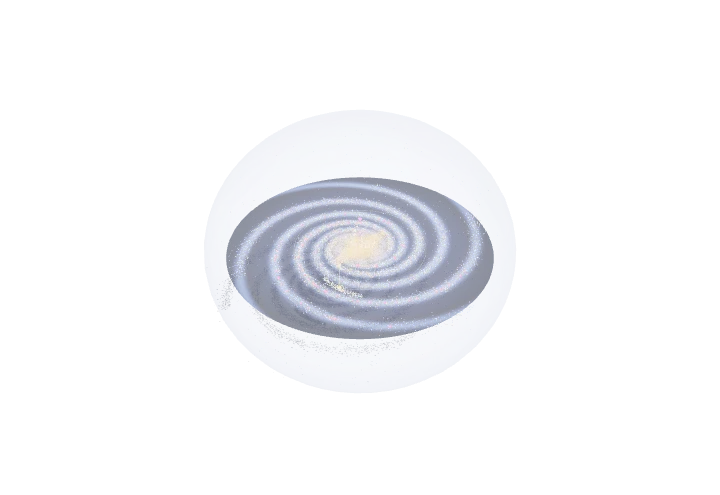
The Milky Way is our galaxy: a flat, spinning disk of a few hundred billion stars with spiral arms and a giant black hole at its centre. The Sun is one ordinary star about halfway out, and it takes roughly 230 million years to go once around. We have mapped it by measuring the positions and speeds of stars and gas clouds, using light that passes through the dust.
The Milky Way is a barred spiral galaxy of a few hundred billion stars, with a thin disk about 30 kpc across, a central bar and bulge around a 4-million-solar-mass black hole, and an extended halo of old stars, globular clusters and dark matter. The Sun orbits about 8 kpc from the centre at roughly 230 km/s, taking about 230 million years per circuit.
Key facts
- Stellar disk diameter
- ≈ 30 kpc (~100,000 light-years)
- Number of stars
- ≈ 1–4 × 10¹¹
- Sun’s distance from centre
- ≈ 8.2 kpc (≈ 27,000 ly)
- Sun’s orbital speed
- ≈ 230 km/s
- Galactic year
- ≈ 220–250 Myr
- Sagittarius A* mass
- ≈ 4.3 × 10⁶ M☉
Parts you can explore (12)
- Central bulge
- Galactic bar
- Sagittarius A*
- Perseus Arm
- Scutum–Centaurus Arm
- Sagittarius–Carina Arm
- Norma–Outer Arm
- Orion Spur
- Galactic disk
- Stellar halo
- Globular clusters
- Sun's position
In the 3D model
Rotate and take apart the model, follow a guided tour of what each part does and why it’s needed, change it with a live slider, and test yourself with a short quiz. Free, no sign-up.
OpenArc Models’ models are simplified teaching schematics. Terms · Privacy