Physics
Michelson interferometer
Wave optics · Interferometry
 Open the interactive 3D model →
How can light measure a movement a hundred times thinner than a human hair?
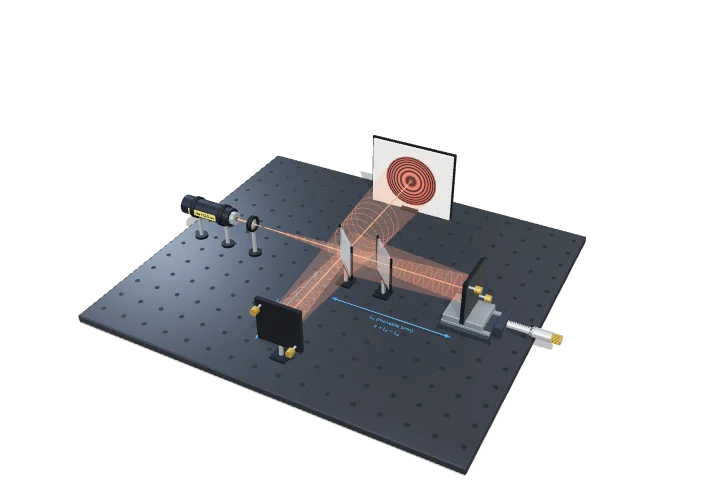
This instrument splits a laser beam in two, sends the halves down two arms to mirrors and brings them back together. Where the light waves arrive in step they make bright rings; where they arrive out of step they cancel into dark rings. Moving one mirror by less than a millionth of a metre makes the rings visibly shift.
A Michelson interferometer splits one light beam into two, sends them along perpendicular arms to two mirrors and recombines them, so that their interference reveals any difference in optical path to a small fraction of a wavelength. Moving one mirror by Δx sweeps N = 2Δx/λ fringes past the centre of the circular pattern, turning light into an extraordinarily fine ruler.
Key facts
- Bright-fringe condition
- 2d cosθ = mλ
- Fringe count for mirror travel Δx
- N = 2Δx/λ
- Travel per fringe (He–Ne, 632.8 nm)
- 0.316 µm
- Model arm difference
- d₀ = 1.20 mm → ≈ 7 rings in the beam
- LIGO arm length
- 4 km; sensitivity ~10⁻¹⁹ m
- Model scale
- Arms ~1:200; mirror motion exaggerated ~10⁵×
Parts you can explore (11)
- Optical breadboard
- He–Ne laser
- Beam-expanding lens
- Beam splitter
- Compensator plate
- Movable mirror M₁
- Micrometer translation stage
- Fixed mirror M₂
- Viewing screen
- Laser beams
- Arm-length markers
In the 3D model
Rotate and take apart the model, follow a guided tour of what each part does and why it’s needed, change it with a live slider, and test yourself with a short quiz. Free, no sign-up.
Open Michelson interferometer in 3D →
OpenArc Models’ models are simplified teaching schematics. Terms · Privacy