Chemistry
Metallic bonding
Solid-state chemistry · Metals
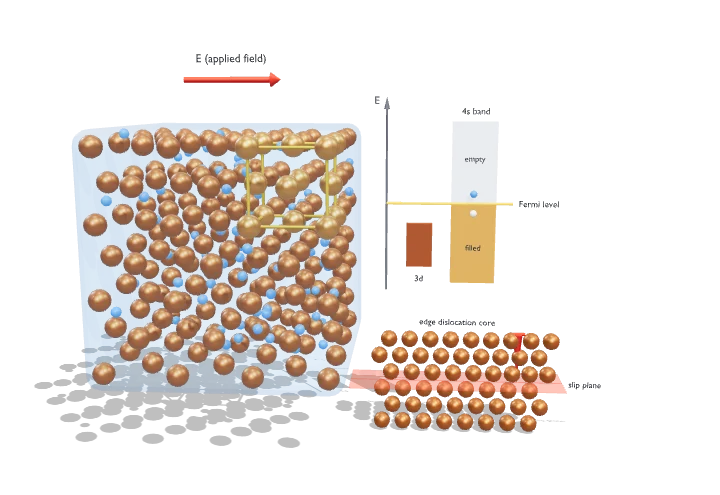 Open the interactive 3D model →
Why can you bend a copper wire into any shape, when a grain of salt just shatters?
In a metal like copper, each atom lets go of its outermost electron. Those electrons are shared by the whole piece of metal, flowing freely between the positive atoms left behind and holding them together like glue. Because the electrons can move, metals carry electricity and heat — and because the glue is everywhere, layers of atoms can slide without breaking apart.
In a metal such as copper each atom releases its valence electrons into states that extend over the whole crystal, so a lattice of positive ion cores is held together by a shared, mobile electron gas. That delocalisation explains the high electrical and thermal conductivity, lustre and ductility of metals, and band theory explains why only partly filled bands conduct.
Key facts
- Crystal structure of Cu
- Face-centred cubic, a = 3.615 Å, 4 atoms per cell
- Nearest-neighbour distance
- 2.556 Å (12 neighbours)
- Conduction-electron density
- 8.5 × 10²⁸ m⁻³ (one 4s electron per atom)
- Resistivity at 20 °C
- 1.68 × 10⁻⁸ Ω m (σ ≈ 5.96 × 10⁷ S/m)
- Fermi energy / speed
- 7.0 eV / 1.57 × 10⁶ m/s
- Drift speed (1 V across 1 m)
- ≈ 4.4 mm/s
Parts you can explore (7)
- Copper cation cores
- FCC unit cell
- Electron sea
- Delocalised electrons
- Applied electric field
- Band structure inset
- Dislocation and slip plane
In the 3D model
Rotate and take apart the model, follow a guided tour of what each part does and why it’s needed, change it with a live slider, and test yourself with a short quiz. Free, no sign-up.
OpenArc Models’ models are simplified teaching schematics. Terms · Privacy